
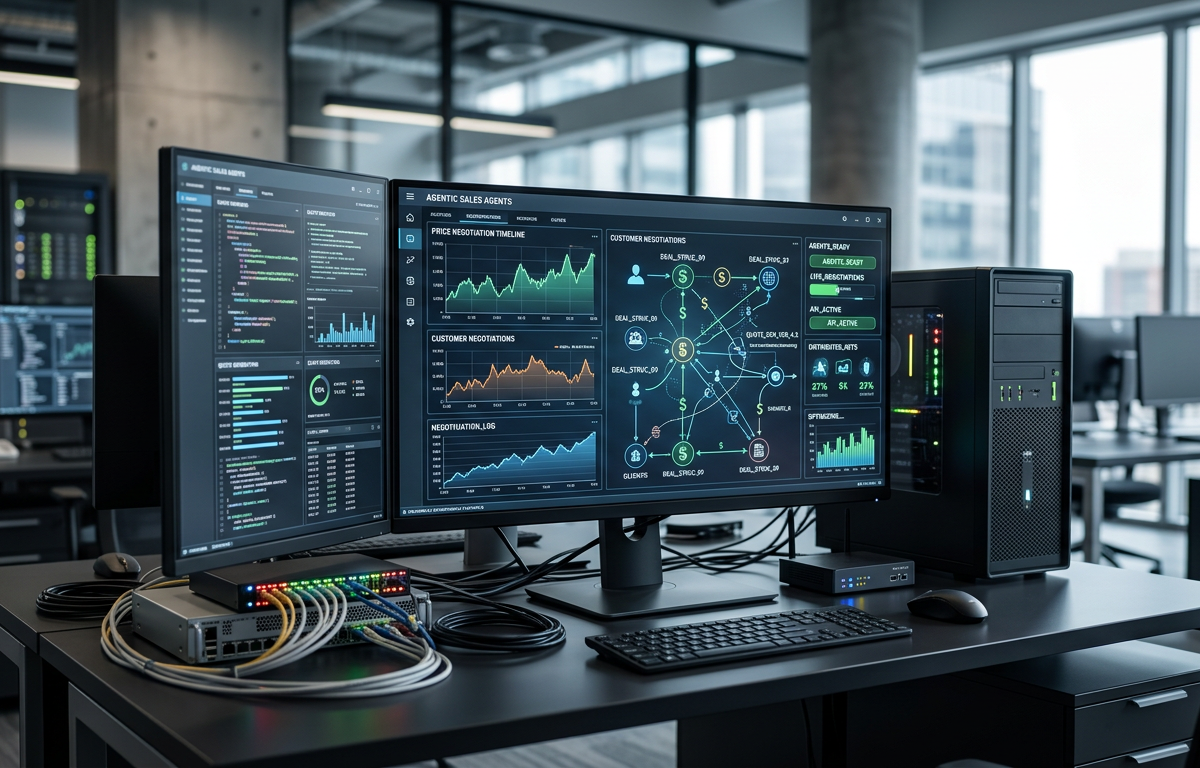
Agentic Sales Agents: When AI Handles Customer Negotiations in Distributed Channels
Most B2B distributors take 2-5 days to generate a complex quote. Sales teams spend 30-40% of their time on quote administration rather than relationship-building. Autonomous negotiation systems can issue quotes in under two minutes—but only if decision thresholds are explicit and governance is built in from the start. Without clear boundaries, AI agents commit companies to commercial terms they didn't intend.
The Quote Bottleneck: Why Sales Can't Keep Up
A foodservice distributor in the East Midlands takes three days to generate quotes for multi-line orders. The sales rep enters the RFQ into a spreadsheet. They check inventory across four depots. They email the pricing team to confirm volume discounts. The pricing team checks margin thresholds with finance. The quote goes back to the rep. The rep sends it to the customer. By the time it arrives, the customer has ordered elsewhere.
This is the quote bottleneck. Typical B2B distributors take 2-5 days to generate a quote for anything beyond standard catalogue pricing. Complex deals involving volume discounts, payment terms, and custom pricing take longer. Sales teams spend 30-40% of their time on quote administration rather than relationship-building (McKinsey, 2024).
The operational cost is measurable. Pricing inconsistency creates margin leakage. Slow response loses deals. Customer frustration drives them to competitors who can quote faster. Across our client implementations, pricing decision time is the primary operational constraint sales directors cite. The quote process is manual, slow, and inconsistent.
Autonomous negotiation systems solve this by removing the human bottleneck. An AI agent accesses pricing rules, inventory, margin thresholds, and customer history in real-time. It generates quotes in seconds, not days. It adjusts terms within pre-set parameters. No sales manager approval required. No email chains. No waiting.
The promise: faster deals, consistent pricing, freed-up sales capacity. The risk: an AI agent committing your company to commercial terms without human oversight. This article explores the operational mechanics, the governance challenges, and what you need in place before deployment.
How Autonomous Negotiation Works: The Mechanics
A customer submits an RFQ through your commerce platform, email, or portal. The AI agent receives it and begins everyday work. It accesses your pricing rules, checks inventory across all locations, calculates cost, applies customer-specific pricing, evaluates margin thresholds, and determines available terms.
The agent generates a quote in real-time. If the deal falls within pre-set parameters, the agent issues the quote. No human approval. No delay. The customer receives a response in 90 seconds instead of three days.
A foodservice distributor we worked with in late 2024 deployed autonomous negotiation for routine orders under £10,000. A customer submits an RFQ for 500 units of frozen vegetables. The agent checks inventory at the nearest depot, calculates cost at £3.20 per unit, applies the customer's contracted 8% discount, offers an additional 5% volume discount (within the programmed threshold of 10%), and issues the quote at £2.85 per unit with a 15% margin. Total elapsed time: 87 seconds.
The manual process for the same quote took 2-3 hours and required sales manager approval. The autonomous system removed the bottleneck entirely. The customer received a faster response. The sales team avoided administrative work. Margin held.
The key mechanic is the decision threshold. The AI operates within guardrails: never go below 15% margin, volume discounts capped at 10%, payment terms limited to net-30, delivery windows standard unless flagged. These thresholds define what the AI can decide without escalation. Platforms like Pactum AI and Sprouts.ai enable this capability. Dynamic Pricing Intelligence provides the governance layer that makes it safe.
Decision Thresholds: Where the AI Stops and Humans Decide
Autonomous negotiation only works if decision boundaries are explicit. Without clear thresholds, the AI either over-escalates (defeating the purpose of autonomy) or under-escalates (committing the company to deals it shouldn't).
We define three threshold categories across our implementations. The autonomous zone covers decisions the AI makes without escalation: standard quotes within margin guardrails, routine volume discounts, standard payment terms, existing customers with clean credit. The AI handles these end-to-end.
The escalation zone covers decisions the AI flags for human review: deals below margin threshold, custom terms, new customer types, orders above a value threshold, requests for extended payment terms beyond policy. The AI generates the quote but routes it for approval rather than issuing it.
The blocked zone covers decisions the AI cannot make: strategic accounts, loss-leader pricing, contract negotiations, pricing for new product categories, deals involving custom delivery or installation. These require human judgement and relationship context the AI doesn't have.
A building materials distributor set a £50,000 deal value threshold in early 2025. Any quote above that automatically escalated to the sales director. The AI agent received an RFQ for £75,000 worth of timber and fixings from a construction firm. It generated the quote, calculated margin at 18%, applied standard trade pricing, and routed the quote to the director for approval rather than issuing it. The director reviewed it, adjusted delivery terms to match the customer's site access constraints, and approved it within 30 minutes.
The threshold prevented the AI from committing the company to a large deal without oversight. It also preserved speed: the quote was issued the same day, compared to the previous 3-day cycle.
Threshold-setting is not a technical task. It's a business governance decision that requires input from finance, sales, and legal. What margin floor can we tolerate? What discount authority should the AI have? What deal size requires director approval? What customer types need human judgement?
Companies that define thresholds clearly see 25-40% faster deal closure (WithPraxis client data, 2025). Those that don't see governance failures within 6-8 weeks: margin violations, customer complaints, pricing errors that weren't caught.
The Governance Challenge: Who's Accountable When the AI Commits?
When an AI agent issues a quote, it commits your company to commercial terms. If the quote is wrong (pricing error, inventory miscalculation, margin violation), who's liable? The sales team didn't approve it. The AI vendor didn't set the thresholds. The finance director who defined the margin floor isn't monitoring every quote.
This is the core governance challenge. Autonomous systems require explicit accountability before deployment, not after problems emerge. Four mechanisms are essential.
The system must log every decision with reasoning, thresholds applied, margin impact, and data sources used. A quote issued at 12% margin when the threshold is 15% should be flagged immediately. A volume discount of 12% when the cap is 10% should trigger an alert. The audit trail allows post-issuance review and threshold refinement.
Even 'autonomous' decisions need spot-checking. A practical approach: review 5-10% of quotes daily. Select randomly or target high-value deals, new customers, or quotes near threshold boundaries. This catches drift before it becomes systemic.
What happens when an AI-issued quote is rejected by the customer? When a quote violates a threshold but wasn't caught in time? When a customer disputes terms the AI committed to? The protocol defines who owns the correction, how the customer is managed, and whether the threshold needs adjustment.
Who owns the decision threshold? Who monitors for drift? Who reviews audit logs? Who approves threshold changes? This is not a technical problem. It's an organisational one.
We explored this in Workflow Ownership in Agentic AI: Who's Responsible When the System Decides?. The short answer: threshold ownership sits with the function that bears the commercial risk. Pricing thresholds are owned by finance. Discount authority is owned by sales leadership. Payment terms are owned by credit control. The AI executes within boundaries those functions define.
A Midlands industrial distributor deployed autonomous negotiation in Q4 2024 without assigning threshold ownership. The AI operated for six weeks before the finance director noticed margin had drifted from 18% to 14% on routine orders. The AI had been applying volume discounts correctly, but the underlying cost data hadn't been updated. The threshold was based on stale cost assumptions. No one was monitoring. No one owned the correction.
The distributor pulled the system offline, updated cost data, tightened thresholds, and assigned a finance analyst to review margin performance weekly. The system went back live three weeks later with clearer accountability. Margin recovered to 17% within a month.
Real-World Constraints: When Autonomous Negotiation Fails
Autonomous systems work well for routine, high-volume quotes with clear parameters. They fail in predictable circumstances.
Customer relationships matter more than price in some deals. Strategic accounts, long-term partnerships, and high-value customers expect human contact. An AI-generated quote feels transactional. A construction supply distributor deployed autonomous negotiation across all customers in early 2025. Within four weeks, three strategic accounts complained. They weren't objecting to the pricing. They were objecting to the absence of their usual sales contact. The distributor pulled strategic accounts out of the autonomous zone and restricted the AI to routine trade orders.
Negotiation is genuinely two-way in some deals. The customer pushes back, asks for custom terms, wants to negotiate delivery windows or payment schedules. The AI can't handle this. It can generate a quote, but it can't negotiate. A foodservice distributor found that 30% of quotes issued were followed by customer requests for adjustments. The AI couldn't respond. The sales team had to step in anyway. The distributor adjusted thresholds to escalate quotes where historical data showed high negotiation likelihood.
Margin pressure is high and thresholds are tight in some markets. The AI can't find a profitable quote within constraints. It either escalates everything (defeating the purpose) or issues quotes that lose deals because they're uncompetitive. A building materials distributor set a 20% margin floor in a market where competitors were operating at 12-15%. The AI escalated 60% of quotes because it couldn't meet the threshold. The distributor lowered the floor to 15% and accepted narrower margins on high-volume products.
Data quality is poor in some systems. Inventory data is stale, customer pricing rules are incomplete, cost data hasn't been updated. The AI quotes products that are out of stock, applies outdated pricing, or miscalculates margin. A construction supply distributor deployed autonomous negotiation without updating inventory sync frequency. The AI quoted products that had sold out hours earlier. Customers ordered, received stock-out notifications, and lost trust. The distributor increased inventory sync to every 15 minutes and restricted the AI to products with real-time stock visibility.
These aren't AI failures. They're governance failures. The AI executed within the parameters it was given. The parameters were wrong. Companies that succeed with autonomous systems spend 4-6 weeks on threshold-setting and data validation before going live (WithPraxis client data, 2025). Those that rush deployment see problems within the first month.
Building the Governance Framework: What You Need Before Deployment
Autonomous negotiation is not a plug-and-play capability. It requires a governance framework built before deployment, not retrofitted after problems emerge.
Start by mapping all quote decision types. Standard catalogue pricing. Volume-based discounts. Customer-specific pricing. Strategic account pricing. New customer quotes. Custom terms. Identify how many of each type you process monthly and what margin variance exists across them.
Define thresholds for each type. Margin floor. Discount cap. Payment term limits. Deal value escalation. Customer type restrictions. Product category restrictions. These thresholds are business decisions, not technical configurations. They require input from finance, sales, credit control, and operations.
Audit existing pricing rules. Are they consistent? Are they documented? Are they based on current cost data? A distributor we worked with in late 2024 discovered that 40% of their pricing rules were undocumented sales rep discretion. The AI couldn't replicate discretion. The rules had to be made explicit.
Set up approval workflows for escalated deals. Who reviews? How quickly? What's the fallback if no one is available? A foodservice distributor configured their system to escalate quotes above £25,000 to the sales director. If the director didn't respond within two hours, the quote escalated to the commercial director. If neither responded within four hours, the system notified the sales rep to handle manually.
Design audit trails and daily review processes. What gets logged? Who reviews it? How often? What triggers an alert? A building materials distributor logs every autonomous quote with margin, discount applied, threshold used, and customer type. A finance analyst reviews 10% daily, selected randomly. Any quote within 2% of a margin threshold gets flagged for manual review.
Assign accountability. Who owns thresholds? Who monitors performance? Who approves changes? A Midlands distributor assigned threshold ownership to finance, daily review to a commercial analyst, and threshold change authority to a monthly governance board with finance, sales, and operations represented.
Test with low-risk quotes first. High-margin products. Routine customers. Standard terms. Small deal sizes. Monitor for a month before expanding scope. A foodservice distributor started with quotes under £5,000 for existing customers ordering standard products. After four weeks with zero margin violations and 98% customer acceptance, they raised the threshold to £10,000 and added volume discount authority.
Monitor for drift. Are thresholds still appropriate? Are margins holding? Are customers accepting quotes? Are escalation rates climbing? A construction supply distributor reviews threshold performance monthly. They've adjusted margin floors twice, tightened discount caps once, and added three new escalation triggers based on six months of operational data.
This is not a two-week project. Proper governance framework design takes 6-8 weeks to validate (WithPraxis client data, 2025). The payoff: 25-40% faster deal closure, 3-8% margin improvement, and zero governance surprises. Learn more about AI Governance and Policy Development and Workflow Mapping and Architecture.
When Autonomy Requires Oversight
Autonomous negotiation works when decision boundaries are explicit, thresholds are business-defined, and governance is built in from the start. It fails when deployed without clarity on what the AI can decide, who's accountable when it commits the company to terms, and how performance is monitored.
The operational benefit is real: quotes in 90 seconds instead of three days, sales teams focused on relationships instead of administration, consistent pricing across all channels. The governance requirement is equally real: clear thresholds, audit trails, escalation protocols, and assigned accountability.
Most distributors who deploy autonomous negotiation successfully spend more time on governance design than technical integration. They map decisions, define thresholds, assign ownership, and test with low-risk quotes before scaling. Those who rush deployment see margin violations, customer complaints, and governance failures within weeks.
The choice is not whether to deploy autonomous negotiation. The choice is whether to deploy it with governance or without it. Learn more about Dynamic Pricing Intelligence.
Common questions
How does autonomous negotiation reduce the time required to issue a multi-line quote?
The AI agent eliminates manual bottlenecks by accessing pricing rules, inventory levels, and margin thresholds in real-time to generate quotes in seconds. This removes the need for email chains between sales, pricing, and finance teams, reducing response times from days to under two minutes. By operating within pre-set parameters, the system issues quotes autonomously without requiring human approval for routine deals.
What operational guardrails prevent an AI agent from committing to unprofitable commercial terms?
Decision thresholds define explicit boundaries for margin floors, volume discount caps, and maximum deal values that the AI must follow. If a request falls outside these programmed parameters, such as a margin below 15%, the system automatically routes the quote to a human manager for review. These governance layers ensure the agent only executes deals that align with the organisation's financial policies.
Which types of distribution deals should remain in the 'blocked zone' for human negotiation?
Strategic accounts, contract negotiations, and deals involving complex delivery or installation requirements are reserved for human judgement. The AI is also restricted from pricing new product categories or loss-leader strategies where relationship context is critical. These high-stakes or non-standard scenarios require a level of nuance that autonomous systems currently lack.
How does the escalation process work when a quote exceeds the AI's autonomous authority?
When a quote exceeds a threshold, such as a specific deal value or custom payment term, the AI generates the draft but flags it for manual intervention. The system routes the prepared quote to the relevant director or sales manager, who can then adjust specific terms or approve the deal. This hybrid approach maintains speed by providing a ready-made quote for review rather than starting the process from scratch.
Tags
Themes

Jack Taylor
UI Frontend Lead
Jack leads frontend development at WithPraxis, focusing on user interface and experience across commerce platforms. He works on translating design systems into performant, maintainable frontend implementations that support usability and consistency at scale.
Connect on LinkedInMore in this cluster
Continue exploring this topic

Commerce operations insights and applications
Agentic AI Observability: Detecting When Your Autonomous Systems Are Operating on Bad Data
Agentic systems fail quietly. A pricing agent drifts 2% below target margin over eight weeks, processing 4,200 decisions before anyone notices. Margin leakage: £87,000. The agent didn't crash or throw errors—it just made slightly wrong decisions, consistently, for two months. Gartner predicts 40% of agentic AI projects will be cancelled by 2027, primarily due to silent degradation that compounds into operational disasters.
Operational workflow improvement
Why Fortune 500 Supply Chain AI Fails at Mid-Market: The Complexity Mismatch Problem
Fifty-seven percent of supply chain leaders cite data quality as the primary barrier to AI adoption. Not model accuracy. Not cost. Data quality. Most mid-market distributors have data spread across five to seven systems with no single source of truth. You cannot train an AI model on conflicting data. The unglamorous work of master data management, integration, and governance must come first.
Operational workflow improvement
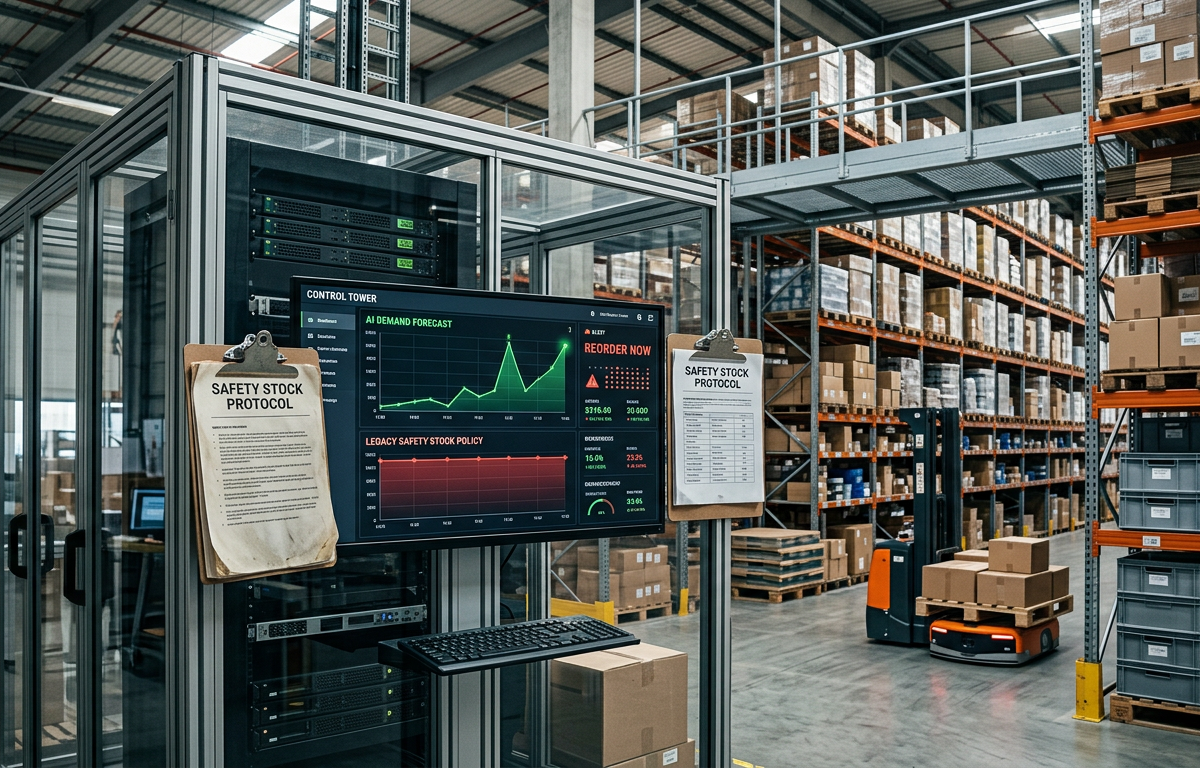
Inventory Decisions Under Uncertainty: When AI Forecasts Conflict With Safety Stock Rules
Deploying demand sensing AI without retiring legacy safety stock policies creates a hidden cost: dual everyday work. Inventory planners second-guess AI recommendations, override autonomous reorder points, and maintain manual guardrails 'just in case.' This article quantifies the cost of running both systems, explains why most deployments fail at the governance layer, and outlines the workflow clarity required to let one system own inventory decisions.
Related Articles
Operational workflow improvement
Why Fortune 500 Supply Chain AI Fails at Mid-Market: The Complexity Mismatch Problem
Fifty-seven percent of supply chain leaders cite data quality as the primary barrier to AI adoption. Not model accuracy. Not cost. Data quality. Most mid-market distributors have data spread across five to seven systems with no single source of truth. You cannot train an AI model on conflicting data. The unglamorous work of master data management, integration, and governance must come first.
Operational workflow improvement
Inventory Decisions Under Uncertainty: When AI Forecasts Conflict With Safety Stock Rules
Deploying demand sensing AI without retiring legacy safety stock policies creates a hidden cost: dual everyday work. Inventory planners second-guess AI recommendations, override autonomous reorder points, and maintain manual guardrails 'just in case.' This article quantifies the cost of running both systems, explains why most deployments fail at the governance layer, and outlines the workflow clarity required to let one system own inventory decisions.
Was this article useful?