
Inventory Decisions Under Uncertainty: When AI Forecasts Conflict With Safety Stock Rules
Deploying demand sensing AI without retiring legacy safety stock policies creates a hidden cost: dual everyday work. Inventory planners second-guess AI recommendations, override autonomous reorder points, and maintain manual guardrails 'just in case.' This article quantifies the cost of running both systems, explains why most deployments fail at the governance layer, and outlines the workflow clarity required to let one system own inventory decisions.
Demand Sensing Deployment: Why Distributors Lose Money Running Dual Inventory Systems
Introduction
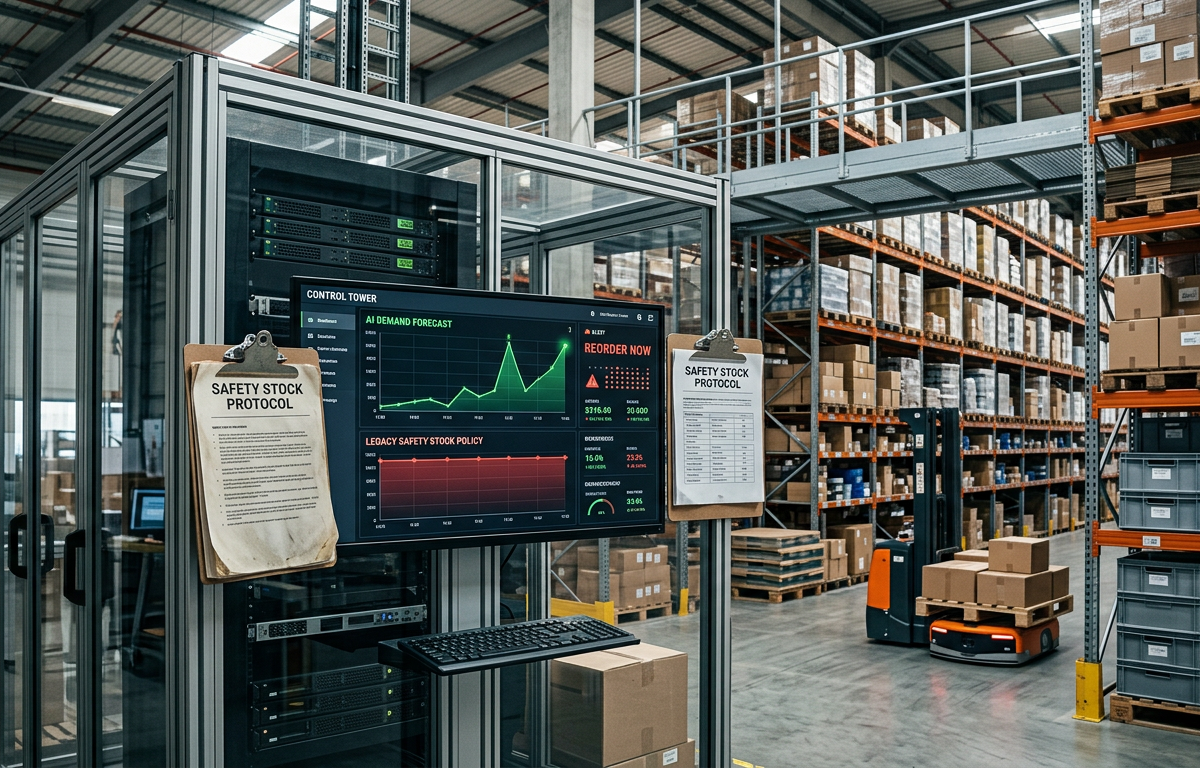
A Midlands foodservice distributor deployed demand sensing AI in January 2024. By March, inventory planners were still checking every reorder recommendation against the old safety stock spreadsheet. The AI suggested cutting frozen vegetable stock by 28%. The legacy policy said maintain 14 days minimum. The planner split the difference and ordered for 10 days. Nobody decided which system owned the decision.
This is the hidden cost of dual inventory systems. Distributors invest £40K-£80K in demand sensing models, then run them alongside legacy safety stock policies. Inventory planners second-guess AI recommendations, maintain manual overrides, and spend 15-25% of their time validating one system against the other. The result: wasted AI investment, slower decisions, and inventory bloat that neither system intended.
The problem isn't the technology. It's governance. Most demand sensing deployments fail because organisations never answer the question: who owns the reorder decision? This article quantifies the cost of running dual systems, explains why governance fails at deployment, and outlines the workflow clarity required to retire legacy policies safely.
The Hidden Cost of Running Dual Inventory Systems
Inventory planners at mid-market distributors spend 15-25% of their time validating AI recommendations against legacy safety stock rules. Across our implementations, manual overrides happen 30-50% of the time in the first three months after deployment. The planner checks the AI reorder point, compares it to the old policy, and chooses whichever feels safer.
This creates four distinct costs. First, wasted AI investment - the model is trained and deployed but not trusted. Second, extended decision cycles - approval loops slow reorder decisions from hours to days. Third, inventory bloat - safety stock stays high because the old policy remains active as a fallback. Fourth, staff confusion - nobody owns the decision, so every reorder becomes a negotiation.
A foodservice distributor in the East Midlands ran both demand sensing and manual safety stock policies for six months. The AI recommended reducing stock on slow-moving frozen lines. The legacy policy said maintain three weeks minimum. Planners compromised by ordering for two weeks. The result: 18-22% excess inventory on those lines and reorder cycles that took 40-50% longer than the AI-only scenario. The distributor paid for the AI model but kept the costs of manual everyday work.
The dual-system overhead compounds over time. Every reorder decision requires validation, every exception requires escalation, every planner meeting revisits the same question: which system do we trust? By month six, the distributor had spent more management time debating reorder points than they saved through AI optimisation.
Why Governance Fails at the Deployment Layer
Most demand sensing deployments fail not because the AI is bad, but because the organisation doesn't retire the old everyday work authority. The AI recommends a reorder point of 850 units. The legacy policy says maintain 1,200 units minimum. The planner orders 1,000 units. This is a governance failure, not a technology failure.
Four root causes drive this pattern. First, fear of stockouts - planners don't trust the model's accuracy, especially on high-volume SKUs where a stockout costs thousands in lost sales. Second, no clear workflow ownership - 'who decides?' is never answered, so every reorder becomes a committee decision. Third, lack of rollback plan - 'what if the AI fails?' creates hesitation because nobody has defined what failure looks like or how to revert safely. Fourth, incentive misalignment - planners are measured on stock availability, not inventory cost, so they default to the safer option: overstock.
Our AI readiness assessments show that mid-market distributors average 5.6 out of 10 on the workflow ownership dimension. Most organisations score well on data quality (7-8 out of 10) but fail at governance (4-6 out of 10). They have the data infrastructure to run demand sensing. They don't have the workflow clarity to retire legacy policies.
A building materials distributor in Yorkshire deployed demand sensing in Q1 2024. By Q2, override rates were still 47%. The AI was accurate - forecast error was under 12% - but planners didn't trust it. When we mapped their decision process, we found no written policy on when to override the AI, no defined escalation path for exceptions, and no measurement of override accuracy. The governance layer didn't exist. The technology worked. The organisation didn't know how to use it.
Workflow Clarity: The Foundation for Retiring Legacy Systems
Retiring dual systems requires explicit workflow clarity before deployment. Define four questions in writing: Who owns the reorder decision? What triggers a manual override? What's the rollback plan if the AI fails? How do we measure success?
The first question is binary. Either the AI system owns routine reorder decisions or human planners do. There is no middle ground that works at scale. A building materials distributor defined workflow ownership as 'AI owns routine reorders on all SKUs with 12+ months of demand history; planners own exception handling for new products, supply disruptions, and price spikes.' This eliminated 60% of dual-system overhead within eight weeks.
The second question prevents override creep. Without defined triggers, planners override the AI whenever it feels wrong. Define specific conditions: supply disruption (lead time doubles), price spike (cost increases >15% in one week), demand anomaly (order volume triples in 48 hours). A foodservice distributor limited overrides to these three triggers. Override rates dropped from 42% to 7% in ten weeks.
The third question addresses fear. Planners resist retiring legacy policies because they don't know how to revert if the AI fails. Define failure explicitly: stockout rate exceeds 3% for two consecutive weeks, or forecast error exceeds 20% for three weeks. Define rollback: revert to manual safety stock policies within 48 hours, measure impact weekly, re-enable AI only after root cause analysis. This clarity reduces resistance because planners know the escape route exists.
The fourth question aligns incentives. Measure inventory turns, cash-to-cash cycle, and stockout rate. A fashion distributor added 'AI override accuracy' as a KPI - when planners overrode the AI, they tracked whether the override improved the outcome. After three months, 73% of overrides made inventory performance worse. This evidence shifted planner behaviour faster than any training programme.
The Transition: From Dual Systems to Controlled Automation
Retiring legacy policies safely requires a phased approach over 12-16 weeks. Phase 1 (Weeks 1-4): Run both systems in parallel, measure divergence between AI recommendations and legacy policy outputs. Track which system would have performed better on actual demand. Phase 2 (Weeks 5-8): Gradually increase AI decision authority on low-risk SKUs - slow-moving lines with stable demand where stockout cost is under £500 per incident.
Phase 3 (Weeks 9-12): Expand to medium-risk SKUs, monitor override rates weekly, and publish results to the planning team. Key metric: override rate should drop from 30-50% to under 10% by week 12. Phase 4 (Weeks 13+): Full AI ownership on all SKUs with sufficient demand history. Humans handle exceptions only - new products, supply disruptions, and anomalies outside model training range.
A fashion distributor in the South East followed this timeline. Week 1: 45% override rate. Week 4: 38%. Week 8: 22%. Week 12: 9%. Week 16: 3%. The reduction wasn't automatic. It required weekly governance reviews where the planning team compared AI recommendations to actual outcomes, identified patterns in override accuracy, and adjusted decision triggers. By week 16, planners trusted the AI on routine decisions and focused their time on strategic work: supplier negotiations, range planning, and seasonal forecasting.
The timeline matters. Organisations that try to retire legacy policies in under eight weeks see override rates stay above 25% because planners don't have enough evidence to trust the AI. Organisations that take longer than 20 weeks create decision fatigue - planners lose confidence in both systems because the transition drags on without resolution. The 12-16 week window balances evidence accumulation with decision momentum.
This requires weekly governance reviews, clear communication with the planning team, and visible leadership commitment. A building materials distributor assigned a senior operations manager to chair weekly transition reviews. Attendance was mandatory. The team reviewed override decisions publicly. This accountability reduced override rates faster than any technical improvement to the AI model.
Measuring Success: Beyond Inventory Metrics
Success isn't just lower inventory. Measure five dimensions. First, workflow delay - time from demand signal to reorder decision. Target: under 2 hours versus 2-3 days for manual decisions. A foodservice distributor reduced workflow delay from 3 days to 4 hours within 12 weeks of retiring legacy policies. This speed advantage captured margin opportunities that manual processes missed.
Second, override rate - percentage of AI recommendations accepted without change. Target: above 95% by week 16. An industrial distributor tracked override accuracy and found that 68% of manual overrides made inventory performance worse. Publishing this data reduced override rates from 34% to 4% in 14 weeks.
Third, inventory turns - SKU-level improvement measured quarterly. Typical improvement: 12-18% within six months. A building materials distributor improved inventory turns by 16% on AI-managed SKUs while maintaining stockout rates under 2%. This freed up £180K in working capital that had been tied up in excess safety stock.
Fourth, planner productivity - time freed for strategic work. Typical time savings: 18-25% of planner capacity. A foodservice distributor freed up 20% of planner time by eliminating dual-system validation. That time shifted to supplier negotiations and range planning - activities that manual safety stock policies never addressed.
Fifth, stockout rate - ensure safety isn't sacrificed. Target: under 2% versus baseline. Across our implementations, stockout rates stay flat or improve slightly when AI owns reorder decisions. The AI responds faster to demand shifts than manual policies, reducing both overstock and stockout risk.
WithPraxis clients report an average 39% improvement in key operational metrics within six months of deployment (WithPraxis client data, 2024-2025). A foodservice distributor improved inventory turns by 16%, reduced decision time from 3 days to 4 hours, freed up 20% of planner capacity, and maintained stockout rates at 1.8% - all within six months of retiring dual systems. The improvement didn't come from better AI. It came from workflow clarity and governance discipline.
Dual inventory systems are a governance problem, not a technology problem. Deploying demand sensing AI without retiring legacy safety stock policies creates hidden costs: wasted investment, extended decision cycles, inventory bloat, and staff confusion. Most deployments fail because organisations don't answer the governance question: who owns this decision?
Retiring legacy policies requires workflow clarity, phased transition, and honest measurement. Define who owns the reorder decision, what triggers manual overrides, and how success is measured. The cost of indecision - running both systems - is higher than the cost of commitment. Workflow clarity is the foundation for autonomous operations. Without it, demand sensing AI becomes another dashboard that sits unused while planners keep running the old spreadsheet.
Learn more about Predictive Replenishment System.
Common questions
What are the primary financial and operational costs of maintaining dual inventory systems during a demand sensing rollout?
Distributors face wasted AI investment, extended decision cycles, and persistent inventory bloat when legacy safety stock policies remain active. Operational efficiency drops as inventory planners spend 15-25% of their time validating AI recommendations against old spreadsheets. This duplication often results in reorder cycles taking 40-50% longer than an AI-only workflow.
How does a lack of clear workflow ownership impact the accuracy of reorder points?
Without defined ownership, planners frequently split the difference between AI recommendations and legacy policies, leading to manual overrides in 30-50% of cases. This compromise creates inventory levels that satisfy neither the AI's optimisation goals nor the legacy safety requirements. Consequently, distributors often carry 18-22% excess inventory on lines where the AI suggested reductions.
What specific triggers should a distributor define to prevent excessive manual overrides of AI recommendations?
Organisations must establish written conditions for intervention, such as supply disruptions where lead times double or price spikes exceeding 15% in a single week. Defining these specific demand anomalies or cost changes prevents planners from overriding the system based on intuition alone. Implementing these triggers has been shown to reduce override rates from over 40% to as low as 7%.
Why do inventory planners often resist retiring legacy safety stock policies in favour of demand sensing models?
Resistance is primarily driven by a fear of stockouts and incentive structures that prioritise stock availability over inventory carrying costs. Planners default to overstocking because they lack a defined rollback plan or clear governance on who owns the final reorder decision. This hesitation is compounded when the organisation fails to provide a technical framework for measuring the accuracy of manual overrides versus AI suggestions.
Tags
Themes

Jack Taylor
UI Frontend Lead
Jack leads frontend development at WithPraxis, focusing on user interface and experience across commerce platforms. He works on translating design systems into performant, maintainable frontend implementations that support usability and consistency at scale.
Connect on LinkedInMore in this cluster
Continue exploring this topic

Commerce operations insights and applications
Agentic AI Observability: Detecting When Your Autonomous Systems Are Operating on Bad Data
Agentic systems fail quietly. A pricing agent drifts 2% below target margin over eight weeks, processing 4,200 decisions before anyone notices. Margin leakage: £87,000. The agent didn't crash or throw errors—it just made slightly wrong decisions, consistently, for two months. Gartner predicts 40% of agentic AI projects will be cancelled by 2027, primarily due to silent degradation that compounds into operational disasters.
Operational workflow improvement
Why Fortune 500 Supply Chain AI Fails at Mid-Market: The Complexity Mismatch Problem
Fifty-seven percent of supply chain leaders cite data quality as the primary barrier to AI adoption. Not model accuracy. Not cost. Data quality. Most mid-market distributors have data spread across five to seven systems with no single source of truth. You cannot train an AI model on conflicting data. The unglamorous work of master data management, integration, and governance must come first.

Operational workflow improvement
Enterprise Operations Fragmentation: Why Mid-Market Distributors Can't Integrate Their Way Out of Workflow Delay
Mid-market distributors run on 5-8 operational systems. They've invested in integration platforms. Yet workflow delay persists. Integration solves data movement, not workflow clarity.
Related Articles
Operational workflow improvement
Why Fortune 500 Supply Chain AI Fails at Mid-Market: The Complexity Mismatch Problem
Fifty-seven percent of supply chain leaders cite data quality as the primary barrier to AI adoption. Not model accuracy. Not cost. Data quality. Most mid-market distributors have data spread across five to seven systems with no single source of truth. You cannot train an AI model on conflicting data. The unglamorous work of master data management, integration, and governance must come first.
Operational workflow improvement
Enterprise Operations Fragmentation: Why Mid-Market Distributors Can't Integrate Their Way Out of Workflow Delay
Mid-market distributors run on 5-8 operational systems. They've invested in integration platforms. Yet workflow delay persists. Integration solves data movement, not workflow clarity.
Was this article useful?