
Task-Specific AI Agents in B2B Commerce: From Procurement to Order Management
A procurement exception flags in your ERP at 4:47pm on Friday. Supplier lead time extends from 14 to 21 days. Inventory on your fastest-moving line drops below reorder point. The alert sits unread until Monday morning. By then, the supplier's order window has closed for the week. You've lost seven days, and your customer delivery commitment is now at risk.
Introduction
A procurement exception flags in your ERP at 4:47pm on Friday. Supplier lead time extends from 14 to 21 days. Inventory on your fastest-moving line drops below reorder point. The alert sits unread until Monday morning. By then, the supplier's order window has closed for the week. You've lost seven days, and your customer delivery commitment is now at risk.
This is the data-to-action gap. Mid-market distributors generate thousands of alerts, exceptions, and signals daily. Most sit in inboxes, dashboards, or spreadsheets for hours or days before anyone acts. Workflow delay costs more than bad decisions: it compounds into missed delivery windows, expedited shipping charges, and margin erosion that never gets recovered.
Task-specific AI agents bridge this gap by automating routine operational workflows: PO approval, order routing, supplier escalation. Gartner predicts 40% of enterprise applications will feature task-specific agents by 2026. This is already happening in mid-market distribution. The question is not whether to deploy agents, but how to do it without breaking your operations.
The Data-to-Action Gap in B2B Procurement
A Midlands electrical wholesaler runs a 12,000 SKU catalogue across four depots. Their ERP flags 60-80 reorder exceptions daily. The procurement team reviews the list each morning, checks supplier availability, validates budget, and generates purchase orders. The cycle takes 3-5 days from alert to PO submission.
By the time the order goes out, demand has shifted. The alert that triggered the reorder is three days old. Stock levels have dropped further, or the customer who drove the demand spike has already gone elsewhere. SupplyChainBrain notes the gap between data and action is still measured in days, sometimes weeks, even in organisations with real-time data infrastructure.
Procurement workflows are manual. Alerts trigger emails. Emails wait in queues. Staff route approvals through spreadsheets. Budget checks require cross-departmental coordination. Each step adds hours or days. The cost is measurable: missed delivery commitments, expedited shipping to cover stockouts, and margin erosion from rushed supplier negotiations. Across our implementations, we consistently see 35-43% improvement in operational metrics once we remove workflow delay. The problem is not data availability. The problem is the time between signal and action.
Task-Specific Agents vs. General-Purpose AI
General-purpose AI platforms promise to solve everything. In practice, they solve nothing well. They are trained on broad datasets, optimised for generic tasks, and require extensive customisation to handle specific operational workflows. A task-specific agent does one thing: it automates a single, well-defined decision with clear inputs, outputs, and guardrails.
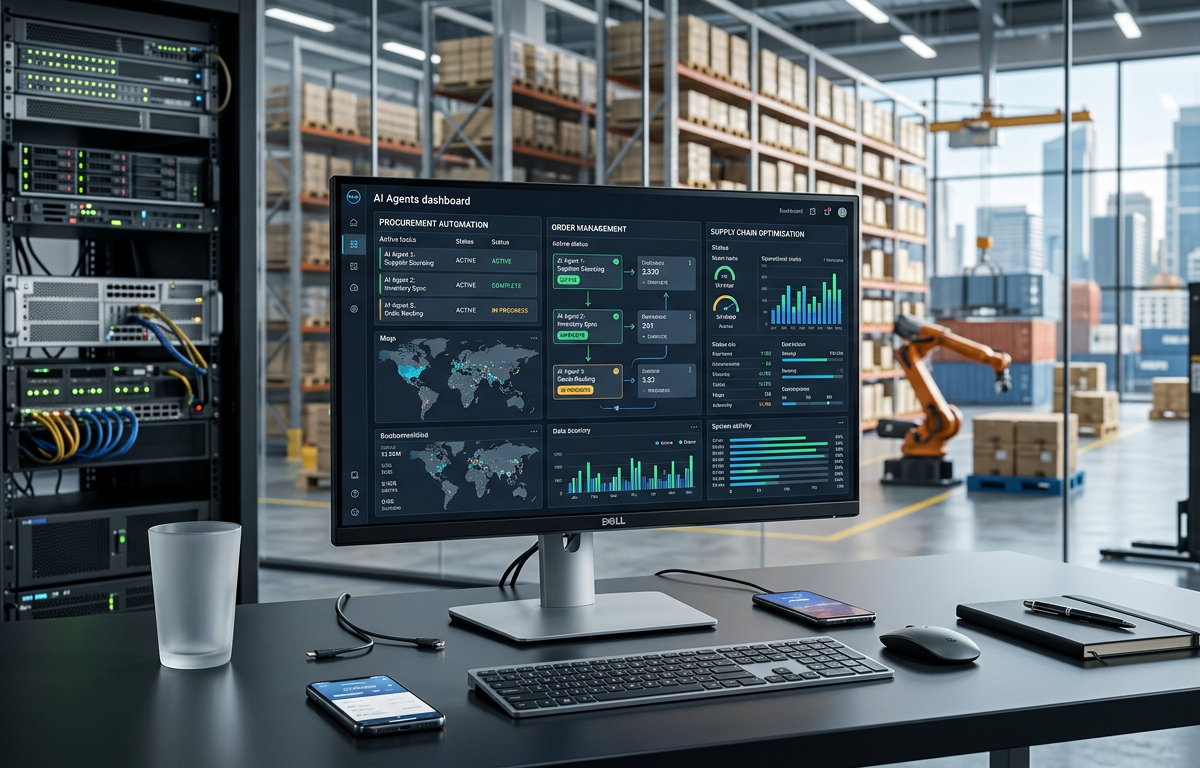
A procurement agent monitors supplier performance, inventory levels, and lead times in real time. When a reorder threshold is breached, it generates a purchase order, checks budget availability against approved spend limits, and routes the PO to the designated approver based on value and category. The entire process takes 30-60 seconds. The agent does not replace the procurement team. It executes the routine decisions they have already defined.
Gartner's AI Agent for Procurement market validates this approach. Task-specific agents operate within defined rules, not autonomously. Humans set the thresholds, approval limits, and escalation paths. The agent executes them consistently, without delay, and without the variability that comes from manual workflows. A general-purpose AI suggests a procurement strategy. A task-specific agent executes the one you already have, faster and more reliably.
Three Core Applications: Procurement, Order Routing, and Engagement
Procurement Automation
Procurement agents monitor supplier performance across delivery times, quality metrics, and pricing competitiveness. When an exception occurs (a lead time extension, a quality flag, a price increase above threshold), the agent evaluates alternatives, checks contract terms, and generates a PO or escalation notice. A 3-5 day manual cycle becomes 30-60 minutes. The procurement team shifts from chasing alerts to managing exceptions the agent cannot resolve: new supplier onboarding, contract renegotiation, category strategy.
Dynamic Order Routing
Order routing agents evaluate inventory availability across multiple depots, delivery windows, cost per route, and customer SLA commitments. They route each order to the optimal location in real time. A Yorkshire building materials distributor reduced fulfilment costs by 18% in 90 days by replacing manual routing decisions with an agent trained on 18 months of delivery data. The agent considers site access constraints, vehicle capacity, and driver availability—factors the manual process often missed under time pressure.
Customer Engagement
Engagement agents handle routine inquiries: order status, product availability, quote requests, invoice queries. They respond via conversational interface (web chat, email, WhatsApp) and escalate complex issues to humans. A foodservice wholesaler reduced support ticket volume by 40-60% within six weeks of deploying an engagement agent. The support team now focuses on high-value interactions: account disputes, technical specification queries, and relationship management. The agent handles the rest.
Implementation Framework: From Pilot to Production
Task-specific agents require four phases. Workflow mapping comes first: identify which decisions are candidates for automation. Not all decisions should be automated. A 4-6 week Workflow Mapping and Architecture engagement identifies 40-60 operational workflows across procurement, fulfilment, and customer service. Typically, 60-80% have automation or clarification potential.
Data readiness follows. Agents need clean, real-time data. If your data is fragmented across five systems (ERP, commerce platform, WMS, CRM, accounting), the agent will fail. Across our AI Readiness assessments, the average score is 5.6/10. Most mid-market distributors are not ready out of the box. Data readiness takes 6-8 weeks: connecting systems, standardising formats, validating accuracy, and establishing refresh cycles under 5 seconds.
Agent design and training takes 8-12 weeks. Define the agent's scope, rules, escalation paths, and guardrails. Train the agent on historical decision data: past POs, routing choices, customer interactions. Test on held-out scenarios. Refine thresholds and logic. This phase determines whether the agent executes your decisions correctly or introduces new errors.
Deployment and monitoring takes 4-6 weeks. Go live on a single decision: PO approval under £5,000, standard order routing, routine customer inquiries. Measure outcomes: decision time, error rate, escalation frequency. Expand scope once confidence is established. Total typical timeline: 6-9 months from kickoff to full production. This is not a quick win. It requires discipline, cross-functional alignment, and governance.
Governance and Control: Keeping Humans in the Loop
Task-specific agents must have clear guardrails. A procurement agent can approve POs up to £5,000 without human review. Above that threshold, it flags for approval. An order routing agent can route standard orders automatically but escalates high-value or complex orders (mixed loads, site access restrictions, urgent delivery windows) to a human. A supplier agent can flag performance issues but cannot unilaterally terminate contracts.
Governance framework defines four elements. Decision authority: what can the agent decide without human input? Escalation rules: when does it ask a human? Audit trails: can we see why it decided that? Override capability: can a human reverse the decision? A Nottinghamshire industrial distributor deployed a routing agent with full audit trails. When a customer complained about a delivery delay, the operations team reviewed the agent's decision log, identified a data error in the delivery window field, corrected it, and retrained the agent. Without the audit trail, the error would have compounded.
This is not optional. It is the difference between a useful tool and a liability. AI Governance and Policy Development establishes these frameworks before deployment, not after. We have seen agents fail because governance was bolted on as an afterthought. Define the rules first. Deploy second.
Conclusion
Task-specific agents reduce workflow delay from days to minutes, but only if you have done the groundwork: data quality, workflow mapping, governance. Gartner predicts 40% of enterprise applications will feature task-specific agents by 2026. The question for mid-market distributors is not whether to deploy agents, but how to do it without breaking your operations.
The answer is systematic. Start with AI Readiness assessment. Map your decisions. Clean your data. Design your agents with clear guardrails. Deploy on a single decision, measure outcomes, expand. Do not skip steps. Workflow delay is costing you margin, delivery performance, and customer trust. Task-specific agents solve this, but only if you build the foundation first.
Learn more about Workflow Mapping and Architecture.
Common questions
How do task-specific agents differ from general-purpose AI in a distribution environment?
Task-specific agents automate single, well-defined decisions with clear inputs and guardrails rather than attempting to solve broad strategic problems. While general AI might suggest a procurement strategy, these agents execute existing rules for tasks like PO generation and order routing in under 60 seconds. This approach ensures consistency and reliability without the variability found in manual workflows or generic AI platforms.
What impact does workflow delay have on procurement and inventory management?
Workflow delay compounds into missed delivery windows, expedited shipping charges, and margin erosion when alerts sit unread in ERP systems. In mid-market distribution, manual cycles often take 3-5 days from an inventory alert to a purchase order submission, causing stockouts when demand shifts during the delay. Removing this gap through automation typically results in a 35-43% improvement in operational metrics.
How can agents optimise fulfilment and order routing across multiple depots?
Routing agents evaluate inventory availability, delivery windows, and cost per route in real time to select the optimal fulfilment location for every order. They incorporate complex variables such as site access constraints and vehicle capacity that manual processes often overlook under time pressure. One building materials distributor achieved an 18% reduction in fulfilment costs within 90 days by deploying an agent trained on historical delivery data.
What is the recommended first step for a distributor looking to deploy AI agents?
The process begins with a four-phase framework starting with workflow mapping to identify which operational tasks are suitable for automation. This initial 4-6 week engagement typically uncovers 40-60 candidate decisions across procurement, fulfilment, and customer service. Following this mapping, the organisation must ensure data readiness to provide the agents with the clean, real-time data required for execution.
Tags
Themes

Ian Gordon
Business Development Director
Ian leads business development at WithPraxis, working closely with clients to define and shape complex commerce programmes. With extensive experience across digital transformation and platform delivery, he focuses on connecting business goals with practical, scalable solutions.
Connect on LinkedInMore in this cluster
Continue exploring this topic

Commerce operations insights and applications
Agentic AI Observability: Detecting When Your Autonomous Systems Are Operating on Bad Data
Agentic systems fail quietly. A pricing agent drifts 2% below target margin over eight weeks, processing 4,200 decisions before anyone notices. Margin leakage: £87,000. The agent didn't crash or throw errors—it just made slightly wrong decisions, consistently, for two months. Gartner predicts 40% of agentic AI projects will be cancelled by 2027, primarily due to silent degradation that compounds into operational disasters.
Operational workflow improvement
Why Fortune 500 Supply Chain AI Fails at Mid-Market: The Complexity Mismatch Problem
Fifty-seven percent of supply chain leaders cite data quality as the primary barrier to AI adoption. Not model accuracy. Not cost. Data quality. Most mid-market distributors have data spread across five to seven systems with no single source of truth. You cannot train an AI model on conflicting data. The unglamorous work of master data management, integration, and governance must come first.
Operational workflow improvement
Inventory Decisions Under Uncertainty: When AI Forecasts Conflict With Safety Stock Rules
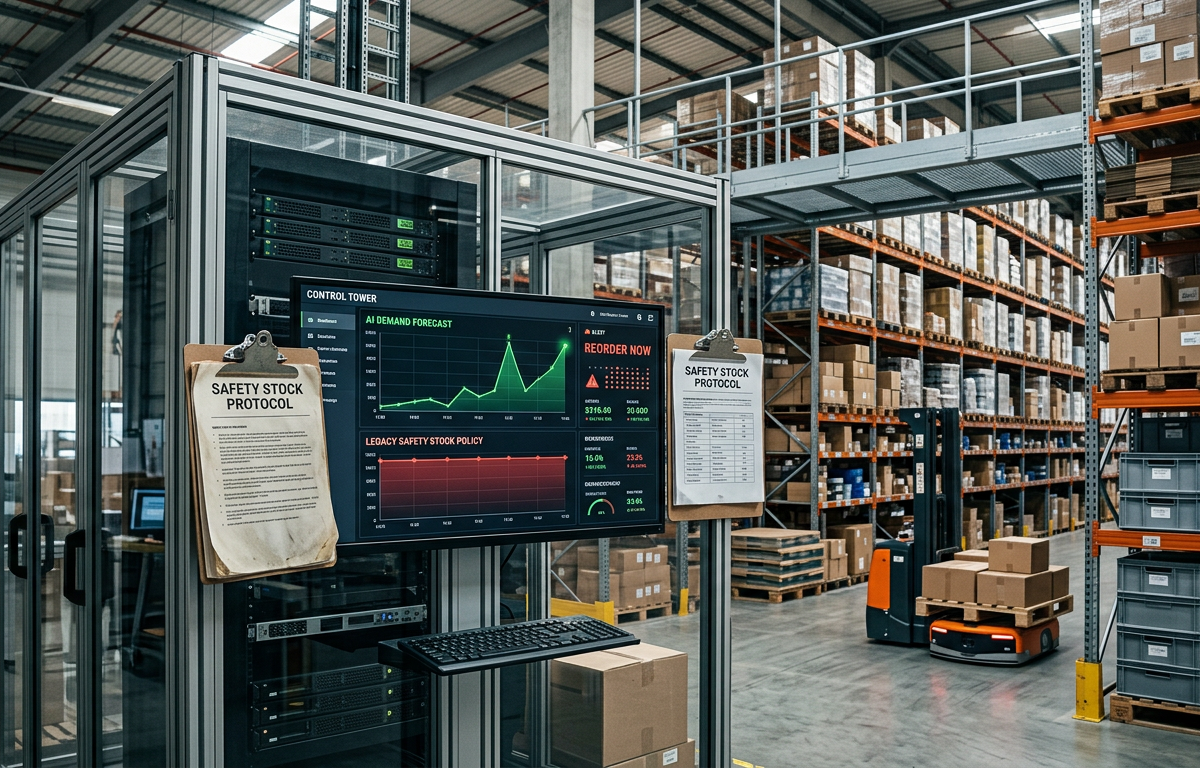
Deploying demand sensing AI without retiring legacy safety stock policies creates a hidden cost: dual everyday work. Inventory planners second-guess AI recommendations, override autonomous reorder points, and maintain manual guardrails 'just in case.' This article quantifies the cost of running both systems, explains why most deployments fail at the governance layer, and outlines the workflow clarity required to let one system own inventory decisions.
Related Articles
Operational workflow improvement
Why Fortune 500 Supply Chain AI Fails at Mid-Market: The Complexity Mismatch Problem
Fifty-seven percent of supply chain leaders cite data quality as the primary barrier to AI adoption. Not model accuracy. Not cost. Data quality. Most mid-market distributors have data spread across five to seven systems with no single source of truth. You cannot train an AI model on conflicting data. The unglamorous work of master data management, integration, and governance must come first.
Operational workflow improvement
Inventory Decisions Under Uncertainty: When AI Forecasts Conflict With Safety Stock Rules
Deploying demand sensing AI without retiring legacy safety stock policies creates a hidden cost: dual everyday work. Inventory planners second-guess AI recommendations, override autonomous reorder points, and maintain manual guardrails 'just in case.' This article quantifies the cost of running both systems, explains why most deployments fail at the governance layer, and outlines the workflow clarity required to let one system own inventory decisions.
Was this article useful?