Thinking
inventory optimisation
All articles tagged with "inventory optimisation".
Operational workflow improvement
Why Fortune 500 Supply Chain AI Fails at Mid-Market: The Complexity Mismatch Problem
Fifty-seven percent of supply chain leaders cite data quality as the primary barrier to AI adoption. Not model accuracy. Not cost. Data quality. Most mid-market distributors have data spread across five to seven systems with no single source of truth. You cannot train an AI model on conflicting data. The unglamorous work of master data management, integration, and governance must come first.

Operational workflow improvement
Inventory Decisions Under Uncertainty: When AI Forecasts Conflict With Safety Stock Rules
Deploying demand sensing AI without retiring legacy safety stock policies creates a hidden cost: dual everyday work. Inventory planners second-guess AI recommendations, override autonomous reorder points, and maintain manual guardrails 'just in case.' This article quantifies the cost of running both systems, explains why most deployments fail at the governance layer, and outlines the workflow clarity required to let one system own inventory decisions.

Operational workflow improvement
Predictive Orchestration: The 2026 Supply Chain AI Priority CSCOs Can't Ignore
Most supply chain directors spend Monday mornings reviewing exceptions from last week. A supplier shipment arrived late. A customer order exceeded forecast. A warehouse ran short on a fast-moving line. By the time the team decides what to do, the problem has compounded.

Platform capabilities and technical insights
Event-Driven Architecture: Real-Time Commerce Operations at Scale
A West Midlands foodservice distributor runs seven systems: SAP for ERP, Shopify Plus for commerce, Manhattan for warehousing, Salesforce for CRM, Xero for accounting, Akeneo for product data, and a legacy routing tool built in-house. None of them talk to each other in real time. Pricing updates take three days. Inventory visibility lags 24 hours behind actual stock. The operations director spends Monday mornings reconciling conflicts created by systems working from different versions of the truth. This is the middleware bottleneck. Mid-market B2B distributors have invested in best-of-breed systems but lack the integration layer to connect them. The B2B middleware market reached £14.1 billion in 2025, growing at 12.23% annually (MarketsandMarkets, 2024). That growth reflects a painful reality: buying good systems is easy, making them work together is not. Event-driven architecture promises to solve this. Order placed, inventory updated, fulfilment triggered, customer notified—all in real time. But most mid-market stacks lack the middleware to orchestrate that sequence. Without it, teams fall back to manual processes and the operational friction compounds.

Operational workflow improvement
Agentic Supply Chain Orchestration: Controlled Automation Across Multi-Depot Networks
Most mid-market distributors allocate stock across depots manually. A buyer reviews demand signals, checks inventory levels, and decides where to send stock. This takes hours or days. By then, demand has shifted. Autonomous agents change this by making allocation decisions in real-time — but only if governance frameworks define the boundaries within which they operate.

Operational workflow improvement
Turning Tacit Expertise into Executable Workflow Support
A pricing manager adjusts margins across 800 SKUs in under an hour. A senior buyer reallocates stock between depots without checking a spreadsheet. A trade counter manager prioritises contractor orders instinctively. All three decisions generate better outcomes than their peers—higher margins, fewer stockouts, faster turnaround. Nobody can explain why.

Operational workflow improvement
Task-Specific AI Agents in B2B Commerce: From Procurement to Order Management
A procurement exception flags in your ERP at 4:47pm on Friday. Supplier lead time extends from 14 to 21 days. Inventory on your fastest-moving line drops below reorder point. The alert sits unread until Monday morning. By then, the supplier's order window has closed for the week. You've lost seven days, and your customer delivery commitment is now at risk.
Operational workflow improvement
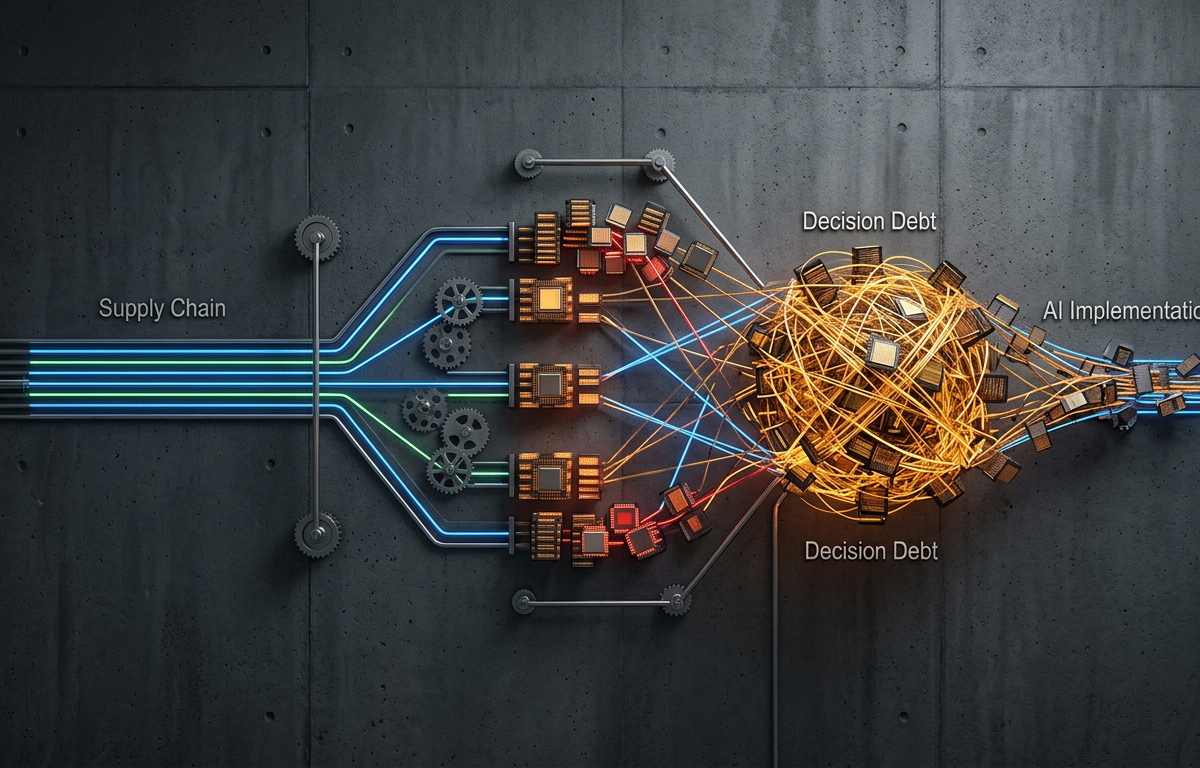
Supply Chain Workflow Debt: How Deferred Planning Choices Compound into AI Failure
Most mid-market distributors rush to AI deployment without auditing what they're actually deciding. A Nottinghamshire food wholesaler spent £85,000 on demand forecasting AI that sat dormant because buying decisions existed only in one person's head. The pre-implementation audit - decision inventory, assumption mapping, rule documentation - is the gate that determines whether AI works or sits unused.

Platform capabilities and technical insights
Build vs Buy vs Partner: The AI Vendor Selection Framework for Mid-Market Distributors
Mid-market distributors face three paths when deploying AI: pre-built vendor models, custom development, or third-party APIs. Most lack a clear framework to evaluate them. The wrong choice delays implementation by 6-12 months and wastes £50,000-£200,000. This decision matrix maps implementation timeline, cost structure, and risk profile for each approach. Pre-built models deploy in 8-12 weeks at lower cost but limited customisation. Custom development takes 16-24 weeks with full control and competitive advantage. Third-party APIs offer middle ground at moderate cost and configuration flexibility. The right choice depends on data maturity, technical capacity, and competitive urgency. A distributor with clean data and a 6-month runway can pursue custom development. A distributor with fragmented systems and a 10-week deadline cannot. Four questions determine the viable path: data quality, timeline urgency, competitive differentiation, and internal technical capacity.

WithPraxis
Fashion Distribution Intelligence: How AI Transforms Seasonal Buying Decisions
Fashion distributors write off £25,000-£45,000 in dead stock each season from three decisions made six months early: style selection, quantities, and size curves. Applied AI transforms seasonal planning by handling complex optimisation while preserving buyer expertise in trend interpretation.