
The Skill Deficit Crisis: Why 84% of Mid-Market Distributors Lack AI-Ready Talent
Mid-market distributors are hiring data scientists for problems that don't need them. The real gap isn't technical capability—it's workflow clarity and domain expertise. Most AI hiring fails because businesses copy tech company job specs instead of recruiting for operational roles that understand distribution workflows.
A £60M foodservice distributor in the Midlands posted a job spec for a Senior Data Scientist last year. Salary: £75,000. Requirements: PhD in machine learning, five years' experience in Python, TensorFlow, and deep learning frameworks. They received 43 applications. They hired someone from a fintech company with strong credentials. Six months later, the hire left. The reason wasn't salary or culture. It was frustration. The data scientist couldn't see how their work connected to business outcomes. The distributor couldn't see how the models connected to operational workflows.
This pattern repeats across mid-market distribution. Businesses invest in AI talent, but they recruit for roles designed for tech companies, not distribution operations. The result: wasted budget, delayed ROI, and friction between technical hires and operations teams. The problem isn't the quality of candidates. It's the mismatch between what distributors think they need and what actually drives value.
This article examines what roles actually deliver ROI in distribution AI, how to structure teams around decisions rather than technical depth, and why traditional tech hiring processes fail in operational environments.
The Data Science Hiring Myth
Most distributors post job specs for data scientists or ML engineers copied from tech company templates. These roles are built for product companies optimising recommendation engines or ad targeting, not for distribution operations. A data scientist at a consumer tech company might spend six months refining a model that improves click-through rates by 0.3%. That work has value at scale. It has no equivalent in distribution.
Distributors don't need generic data scientists. Our AI readiness assessments across mid-market distributors show an average score of 5.6 out of 10. The gap isn't technical capability. It's operational clarity. Most distributors can't articulate what decisions they're trying to improve, who owns those decisions, or what success looks like. Hiring a data scientist before mapping decisions is like hiring an architect before defining the building.
A foodservice distributor hired a data scientist to improve pricing. The brief was vague: "use AI to optimise margins." The data scientist built a price elasticity model. It was technically sound. But the business had no decision framework for what "better pricing" meant. Should the model prioritise volume, margin, or customer retention? Who approves price changes? What happens when the model conflicts with sales team judgement? These questions weren't answered. The model sat unused. The hire left after 18 months.
The failure wasn't technical. It was structural. The distributor hired for technical depth without operational clarity.
What Distributors Actually Need: Decision Architects
The real gap is decision architects, people who understand how AI changes distributor workflows. These roles sit between operations and technology. They map decisions, define success metrics, and translate business problems into AI requirements. They don't need to write production code. They need to understand pricing decisions, fulfilment routing, inventory allocation, and credit approval well enough to know where AI adds value and where it doesn't.
Decision architects drive ROI faster than data scientists. Our client data shows 39% improvement in operational metrics within six months of deployment (WithPraxis client data, 2025). This happens because workflow clarity precedes technical implementation. A well-mapped workflow problem can be solved with simple automation, a rules engine, or a lightweight model. Most distribution problems don't need deep learning. They need clear ownership and structured logic.
A building materials distributor in Yorkshire hired a Fulfilment Operations Lead with eight years of logistics experience and no AI background. Within four weeks, this person identified 12 routing decisions that could be automated: depot selection based on stock availability, delivery sequencing based on site access windows, driver allocation based on vehicle capacity and product type. A data scientist would have spent eight weeks building models for problems that weren't clearly defined. The operations lead mapped the decisions first, then specified what the system needed to do. The result: 18% fulfilment cost reduction within 120 days.
Hire for workflow clarity first, technical depth second. The operations lead didn't write the routing algorithm. They defined the problem well enough that a technical integrator could implement it.
Domain Expertise Over Generic Tech Talent
Distribution is specific. Foodservice has perishable inventory and kitchen timing constraints. Industrial distribution has part-number complexity and trade customer behaviour. Construction supply has mixed-load routing and site access constraints. Generic AI talent doesn't understand these nuances. They build models that work in theory but fail in practice because they miss operational context.
A foodservice distributor recovered £180,000 to £240,000 in annual margin because the team understood commodity price volatility and approval workflows (WithPraxis client data, 2024). They knew that pricing decisions took three days not because the spreadsheet was slow, but because of email approval chains and manual cross-checks. A generic data scientist wouldn't have known that. They would have optimised the wrong part of the process.
A fashion retailer hired a Markdown Optimisation Specialist with six years of retail buying experience. This person understood seasonal demand patterns, cash flow constraints, and clearance psychology. They knew that markdown timing matters as much as markdown depth. They knew that end-of-season clearance competes with new season launches for customer attention. A data scientist would have built a model. The specialist built a decision framework that the business could own and operate. The result: 8% margin improvement and 25% faster inventory clearance.
Hire operations people first, upskill them in AI concepts second. It's easier to teach an experienced operations lead how AI works than to teach a data scientist how distribution works. The learning curve for AI concepts is measured in weeks. The learning curve for distribution domain expertise is measured in years.
How to Structure AI Teams for Distribution Operations
Most tech companies structure AI teams vertically: data engineers, data scientists, ML engineers, MLOps. Each role has a narrow technical focus. This structure works for product companies building consumer-facing features at scale. It doesn't work for distribution, where the value comes from cross-functional coordination and operational fit.
Distribution AI teams should be horizontal and decision-focused. We've delivered measurable outcomes across six client engagements by structuring teams around decisions, not technical roles. The structure: a decision lead with operations background, a technical integrator with systems and data background, and domain specialists in pricing, fulfilment, or inventory. This team moves faster because they share a common language and a common objective.
A £60M foodservice distributor structured their AI team as follows: Pricing Operations Lead (former category manager), Systems Integration Engineer (former ERP administrator), Fulfilment Analyst (former warehouse manager). The Pricing Operations Lead mapped pricing decisions and defined success metrics. The Systems Integration Engineer connected the ERP, commerce platform, and supplier data feeds. The Fulfilment Analyst identified routing decisions and tested recommendations against real delivery schedules. This team reduced pricing decision time from three days to 30 minutes and achieved 6% margin improvement within 90 days.
A traditional data science team would have spent three months building infrastructure, another three months training models, and another three months negotiating with operations about how to deploy them. The horizontal team shipped value in six weeks because they started with workflow clarity and operational buy-in.
Hire for cross-functional coordination, not technical specialisation. The technical integrator doesn't need to be a world-class ML engineer. They need to understand how to connect systems, move data, and deploy lightweight models. The decision lead doesn't need to code. They need to map decisions and define metrics. The domain specialists don't need technical depth. They need operational experience and willingness to learn AI concepts.
Why Traditional Tech Hiring Fails in Distribution
Tech hiring is optimised for scale, speed, and innovation. Candidates are assessed on algorithm knowledge, coding speed, and system design. Interviews focus on technical depth. Job specs emphasise credentials: degrees, publications, years of experience with specific frameworks. This process works for tech companies building consumer products. It doesn't work for distribution, where the value comes from operational clarity and business context.
Distributors report high turnover in data science hires, 18 to 24 months is typical, because the role lacks operational context. A data scientist hired from a tech company expects to work on technically interesting problems with clear success metrics and fast feedback loops. Distribution offers none of these. The problems are messy. The metrics are ambiguous. The feedback loops are slow because operational changes take weeks to show results.
A distributor hired a Senior Data Scientist from a fintech company. The hire had strong ML credentials: publications, Kaggle competitions, open-source contributions. After six months, the person was frustrated because "the business doesn't understand what I'm building." The distributor was frustrated because the hire wasn't solving real problems. Both parties were right. The role was misaligned. The data scientist wanted to optimise models. The distributor needed someone to map decisions and translate business problems into technical requirements. These are different jobs.
Hire differently. Focus on workflow ownership, operational experience, and willingness to learn AI concepts, not the reverse. Interview candidates on how they would map a pricing decision or define success metrics for fulfilment routing. Ask them to explain a distribution workflow and identify where AI might add value. Assess their ability to translate between business language and technical language. These skills matter more than algorithm knowledge or coding speed.
Tech companies hire for technical depth because that's their constraint. Distribution's constraint is operational clarity. Hire for the constraint you actually have.
The Path Forward
Distributors need to stop copying tech company hiring playbooks and start hiring for workflow clarity and domain expertise. The ROI comes from understanding the business, not from technical depth. A decision architect with eight years of distribution experience will deliver more value in six months than a data scientist with a PhD will deliver in two years, because the decision architect knows which problems to solve and how to translate them into requirements the business can act on.
The hiring trap wastes budget, delays ROI, and creates friction between technical hires and operations teams. The way out is to recognise that distribution AI is an operational discipline, not a technical one. Hire operations people who understand decisions. Upskill them in AI concepts. Structure teams around decisions, not technical roles. The businesses that do this will see measurable results within quarters. The businesses that don't will keep hiring data scientists who leave after 18 months.
Building the right AI team starts with clarity on what decisions you're trying to improve. Learn more about Workflow Mapping and Architecture.
Common questions
Why do traditional data science hires often fail within mid-market distribution organisations?
Traditional data science roles are typically designed for tech companies focusing on model refinement rather than the operational nuances of distribution. These hires often struggle because they lack a clear connection to business outcomes and the distributor has not yet mapped the specific decisions the AI is intended to improve.
What specific role should a distributor prioritise over a generic machine learning engineer to ensure ROI?
Distributors should prioritise hiring decision architects who sit between operations and technology to map workflows and define success metrics. These individuals focus on translating business problems, such as inventory allocation or credit approval, into technical requirements that drive faster operational improvements than deep technical expertise alone.
How does domain expertise impact the success of AI implementation in fulfilment and logistics?
Domain expertise ensures that AI models account for practical constraints like site access windows, vehicle capacity, and perishable inventory requirements. An operations lead with sector experience can identify and map automatable decisions, such as depot selection, far more effectively than a technical hire who lacks context on distribution logic.
What is the primary risk of hiring for technical depth before establishing operational clarity?
Hiring for technical depth prematurely leads to the development of models that are technically sound but remain unused because they conflict with existing sales judgements or lack a framework for approval. This mismatch results in wasted recruitment budgets, delayed ROI, and high turnover of technical staff who feel their work is disconnected from the business.
Tags
Themes

Andrew Pemberton
Co-founder & Development Director
Andrew is a co-founder of WithPraxis. With 25 years in commerce and technology development, he leads the build side of every engagement, turning AI strategy into working systems that fit how mid-market businesses actually operate. He has delivered projects across distribution, manufacturing, and retail for businesses from regional independents to national operators.
Connect on LinkedInMore in this cluster
Continue exploring this topic
Commerce operations insights and applications
Agentic AI Observability: Detecting When Your Autonomous Systems Are Operating on Bad Data
Agentic systems fail quietly. A pricing agent drifts 2% below target margin over eight weeks, processing 4,200 decisions before anyone notices. Margin leakage: £87,000. The agent didn't crash or throw errors—it just made slightly wrong decisions, consistently, for two months. Gartner predicts 40% of agentic AI projects will be cancelled by 2027, primarily due to silent degradation that compounds into operational disasters.
Operational workflow improvement
Why Fortune 500 Supply Chain AI Fails at Mid-Market: The Complexity Mismatch Problem
Fifty-seven percent of supply chain leaders cite data quality as the primary barrier to AI adoption. Not model accuracy. Not cost. Data quality. Most mid-market distributors have data spread across five to seven systems with no single source of truth. You cannot train an AI model on conflicting data. The unglamorous work of master data management, integration, and governance must come first.
Operational workflow improvement
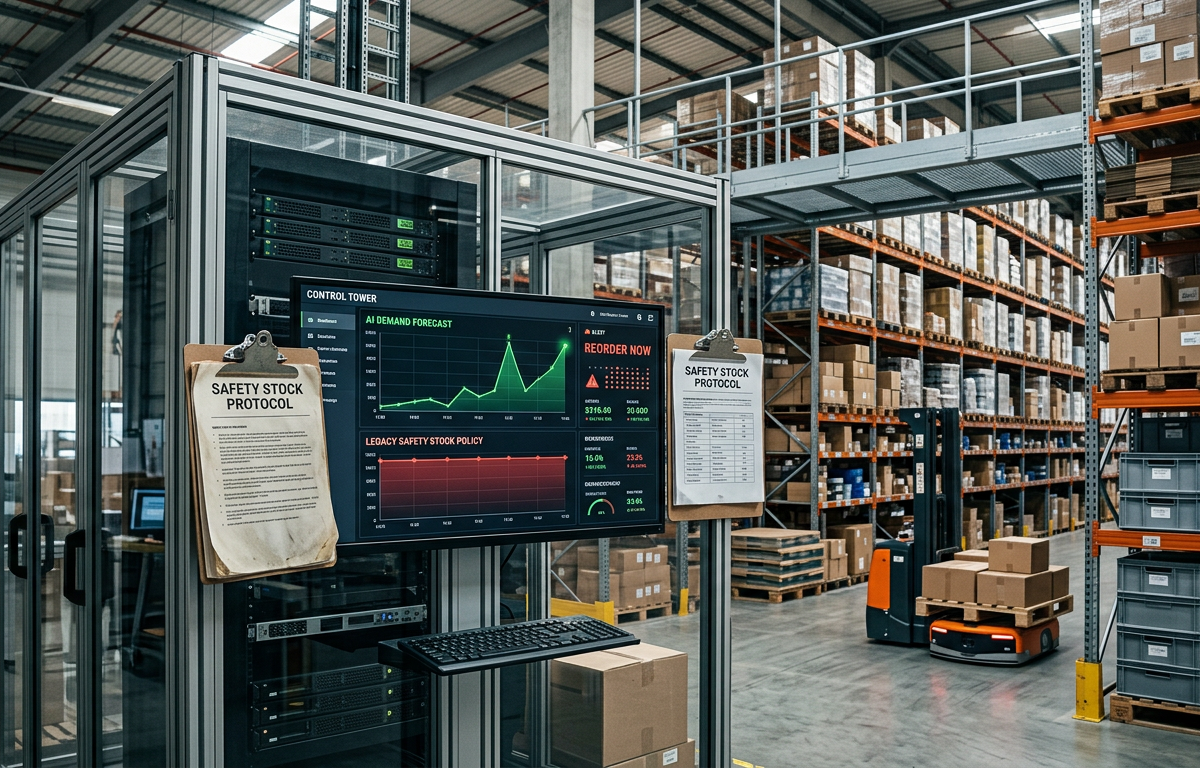
Inventory Decisions Under Uncertainty: When AI Forecasts Conflict With Safety Stock Rules
Deploying demand sensing AI without retiring legacy safety stock policies creates a hidden cost: dual everyday work. Inventory planners second-guess AI recommendations, override autonomous reorder points, and maintain manual guardrails 'just in case.' This article quantifies the cost of running both systems, explains why most deployments fail at the governance layer, and outlines the workflow clarity required to let one system own inventory decisions.
Related Articles
Operational workflow improvement
Why Fortune 500 Supply Chain AI Fails at Mid-Market: The Complexity Mismatch Problem
Fifty-seven percent of supply chain leaders cite data quality as the primary barrier to AI adoption. Not model accuracy. Not cost. Data quality. Most mid-market distributors have data spread across five to seven systems with no single source of truth. You cannot train an AI model on conflicting data. The unglamorous work of master data management, integration, and governance must come first.
Operational workflow improvement
Inventory Decisions Under Uncertainty: When AI Forecasts Conflict With Safety Stock Rules
Deploying demand sensing AI without retiring legacy safety stock policies creates a hidden cost: dual everyday work. Inventory planners second-guess AI recommendations, override autonomous reorder points, and maintain manual guardrails 'just in case.' This article quantifies the cost of running both systems, explains why most deployments fail at the governance layer, and outlines the workflow clarity required to let one system own inventory decisions.
Was this article useful?