

Predictive Orchestration: The 2026 Supply Chain AI Priority CSCOs Can't Ignore
Most supply chain directors spend Monday mornings reviewing exceptions from last week. A supplier shipment arrived late. A customer order exceeded forecast. A warehouse ran short on a fast-moving line. By the time the team decides what to do, the problem has compounded.
Most supply chain directors spend Monday mornings reviewing exceptions from last week. A supplier shipment arrived late. A customer order exceeded forecast. A warehouse ran short on a fast-moving line. By the time the team decides what to do, the problem has compounded.
Gartner's 2026 supply chain outlook names predictive orchestration as the critical AI capability for chief supply chain officers. Not better dashboards. Not more accurate forecasts. Orchestration: the automated execution of decisions triggered by predictions. For mid-market distributors managing £30M-£150M in annual revenue, this represents a fundamental shift from planning to action.
This article examines what predictive orchestration actually means, why most distributors aren't ready, and the foundational work required before deployment. We focus on operational workflows (inventory allocation, supplier orders, fulfilment routing) where orchestration delivers measurable outcomes within six months.
What Predictive Orchestration Actually Means (And Why It's Not Just Better Forecasting)
Predictive orchestration automates the decisions that follow from predictions. Traditional demand forecasting tells you a product will spike in three weeks. Orchestration automatically adjusts inventory allocation across your depot network, triggers supplier purchase orders, and reroutes inbound shipments to match anticipated demand geography.
Most supply chain AI stops at prediction. A model forecasts demand, generates a report, and waits for someone to act. Orchestration closes the loop. The system makes the decision and executes it across connected systems: ERP, warehouse management, transport management, supplier portals.
Consider a foodservice distributor in the East Midlands managing 8,000 SKUs with volatile demand driven by weather, local events, and seasonal patterns. Currently, responding to a demand shift requires three to five days. The buying team reviews forecasts, adjusts orders manually, emails suppliers, waits for confirmation, updates the WMS. By the time stock arrives, demand has often shifted again.
With orchestration, the system detects the demand signal, calculates optimal stock positions across four depots, generates supplier orders within approved parameters, and confirms delivery schedules. Decision time drops from days to hours. The buying team shifts from execution to exception management, reviewing only the decisions that fall outside normal parameters.
Gartner's 2026 outlook positions this capability as non-negotiable for CSCOs facing compressed decision cycles and margin pressure.
The Visibility Gap: Why Most Mid-Market Distributors Aren't Ready
Predictive orchestration requires real-time visibility across suppliers, inventory, and customer demand. Most mid-market distributors lack this foundation. WithPraxis client data shows an average AI readiness score of 5.6 out of 10 across operational capability assessments conducted in 2024-2025. Data fragmentation is the primary blocker.
A £50M distributor we assessed operates four warehouses, sources from 120 suppliers, and serves 800 active trade customers. Inventory data sits in their WMS. Supplier lead times and pricing live in spreadsheets maintained by three different buyers. Customer order history resides in their commerce platform. Financial data is in the ERP. No single system has a complete view.
Each system works adequately for its purpose. The problem emerges when you try to orchestrate decisions across them.
Orchestration needs to know current stock levels, inbound shipments, customer order patterns, supplier constraints, and cost structures simultaneously. If that data exists in five disconnected systems with different update frequencies and data models, orchestration cannot function. You get partial decisions based on incomplete information.
Proper data integration takes 8-12 weeks for a typical mid-market distributor. This involves connecting systems, standardising data models, establishing refresh frequencies, and validating accuracy. Learn more about Data Quality and Migration.
Workflow Automation vs. Workflow Support: The Orchestration Distinction
Predictive orchestration is autonomous everyday work, not workflow support. It automatically executes decisions (adjust stock, trigger orders, route shipments) without human approval loops.
Workflow support presents recommendations. A pricing tool suggests a new price; a manager reviews and approves it. Workflow automation removes the approval step. The system adjusts prices autonomously within defined guardrails. The manager reviews exceptions, not every decision.
A building materials distributor in Yorkshire currently requires three days to adjust trade pricing across 6,000 SKUs. The pricing manager reviews cost changes, calculates margins, updates spreadsheets, and uploads to the ERP. With orchestration, the system adjusts prices autonomously when supplier costs change, maintaining target margins within approved bands. The manager reviews only the adjustments that fall outside normal parameters (typically 5-8% of total changes).
This requires governance frameworks and clear workflow ownership. Who defines the guardrails? Who monitors controlled automation? Who owns the outcome when the system makes a mistake? These questions must be answered before deployment, not after.
Controlled automation need monitoring and control systems. Real-time alerts when decisions breach thresholds. Audit logs showing what was changed and why. Override mechanisms when human judgement is required. Learn more about AI Governance and Policy Development.
The 2026 CSCO Playbook: Three Priorities Before Deployment
CSCOs should prioritise three things before implementing predictive orchestration. Skip any of these and orchestration fails. Address all three and deployment becomes straightforward.
First: workflow mapping. Identify which supply chain decisions can be automated and which need human judgement. A Workflow Mapping workshop takes one day with the right people in the room (operations director, warehouse managers, buying team, finance). Documentation takes two weeks. The output is a prioritised list of 40-60 operational workflows with automation potential scored against impact and feasibility.
Second: data integration. Establish real-time visibility across all systems. This means connecting your ERP, WMS, commerce platform, supplier portals, and transport management system into a unified data foundation. WithPraxis typically implements this using our Bytebard Data Mesh capability, which takes 8-12 weeks for a mid-market distributor with four to six systems. Learn more about System Integration and Data Pipeline Development.
Third: governance. Define guardrails, monitoring, and escalation rules. What decisions can the system make autonomously? What thresholds trigger human review? Who gets alerted when something goes wrong? This framework takes 4-6 weeks to develop and requires input from operations, finance, and legal.
This is 4-6 months of foundational work before orchestration goes live. Organisations that skip workflow mapping deploy orchestration without clarity on what they're automating. Organisations that skip data integration deploy orchestration on incomplete information. Organisations that skip governance deploy orchestration without control.
Measuring Success: What 'Orchestration Ready' Actually Looks Like
Orchestration success is measurable through faster decisions, lower costs, and fewer errors. WithPraxis clients report 39% improvement in key operational metrics within six months of deployment (WithPraxis client data, 2024-2025).
Typical outcomes include decision time reduced 60-80%, fulfilment costs down 15-25%, and inventory turns up 20-30%. A foodservice distributor in the East Midlands moved from three-day pricing cycles to 30-minute autonomous adjustments, recovering £180K-£240K in annual margin. A building materials distributor reduced fulfilment costs by 18% through automated routing that accounts for vehicle capacity, site access constraints, and delivery windows.
Results depend on decision complexity and data quality. Simple decisions (reorder points for fast-moving SKUs) show improvement within weeks. Complex decisions (multi-depot allocation with supplier constraints) take longer to optimise. Data quality determines accuracy. Clean, complete data produces reliable orchestration. Fragmented, inconsistent data produces unreliable orchestration.
Orchestration readiness has three markers. First: single source of truth for operational data. No more reconciling different numbers from different systems. Second: documented workflow ownership. Every operational decision has a named owner and defined parameters. Third: governance framework in place. Guardrails, monitoring, and escalation rules documented and tested.
Organisations that achieve these three markers deploy orchestration successfully. Organisations that skip any of them struggle with adoption, accuracy, or control.
Predictive orchestration is the 2026 supply chain priority because it moves CSCOs from planning to automation. But it requires foundational work: data integration, workflow clarity, governance. The organisations that start now with readiness assessment and workflow mapping will be ready to deploy orchestration in 2026. Those that wait will be playing catch-up.
The work isn't glamorous. Mapping decisions, connecting systems, defining guardrails. But it's the work that determines whether orchestration succeeds or fails. Learn more about AI Readiness.
Predictive orchestration automates the replenishment decisions that consume buying team time and create stockout risk. Learn more about Predictive Replenishment System.
Common questions
How does predictive orchestration differ from traditional demand forecasting in a distribution environment?
Predictive orchestration automates the execution of decisions triggered by predictions rather than simply generating reports for human review. While forecasting identifies a future demand spike, orchestration automatically adjusts inventory allocation, triggers supplier purchase orders, and reroutes shipments across the depot network. This closes the loop between insight and action, moving the buying team from manual execution to exception management.
What are the primary data requirements for a distributor to implement autonomous everyday work?
Implementation requires real-time visibility and integration across ERP, WMS, commerce platforms, and supplier portals to create a single view of operations. Orchestration systems must simultaneously access stock levels, inbound shipments, customer patterns, and supplier constraints to function effectively. Most mid-market distributors require eight to twelve weeks of foundational work to standardise data models and establish necessary refresh frequencies.
How does the shift to workflow automation change the role of a pricing or procurement manager?
Managers transition from manual data entry and routine approvals to defining guardrails and managing high-level exceptions. Instead of reviewing every price change or purchase order, the system executes adjustments autonomously within approved parameters, such as maintaining target margins. This reduces decision cycles from days to hours and allows staff to focus on the small percentage of cases that fall outside normal operational boundaries.
What operational risks must be addressed before deploying predictive orchestration in the supply chain?
Organisations must establish clear governance frameworks, audit logs, and override mechanisms to manage controlled automation. It is essential to define who owns the outcome of automated actions and who sets the thresholds for system alerts. Without these control systems and defined workflow ownership, the organisation cannot safely monitor or intervene when the system encounters scenarios outside its programmed parameters.
Tags
Themes

Nick Pinson
Managing Director
Nick leads WithPraxis as Managing Director, overseeing strategy, delivery, and long-term client partnerships. With deep experience in digital commerce and business operations, he focuses on aligning technology investment with commercial outcomes for mid-market and enterprise businesses.
Connect on LinkedInMore in this cluster
Continue exploring this topic

Commerce operations insights and applications
Agentic AI Observability: Detecting When Your Autonomous Systems Are Operating on Bad Data
Agentic systems fail quietly. A pricing agent drifts 2% below target margin over eight weeks, processing 4,200 decisions before anyone notices. Margin leakage: £87,000. The agent didn't crash or throw errors—it just made slightly wrong decisions, consistently, for two months. Gartner predicts 40% of agentic AI projects will be cancelled by 2027, primarily due to silent degradation that compounds into operational disasters.
Operational workflow improvement
Why Fortune 500 Supply Chain AI Fails at Mid-Market: The Complexity Mismatch Problem
Fifty-seven percent of supply chain leaders cite data quality as the primary barrier to AI adoption. Not model accuracy. Not cost. Data quality. Most mid-market distributors have data spread across five to seven systems with no single source of truth. You cannot train an AI model on conflicting data. The unglamorous work of master data management, integration, and governance must come first.
Operational workflow improvement
Inventory Decisions Under Uncertainty: When AI Forecasts Conflict With Safety Stock Rules
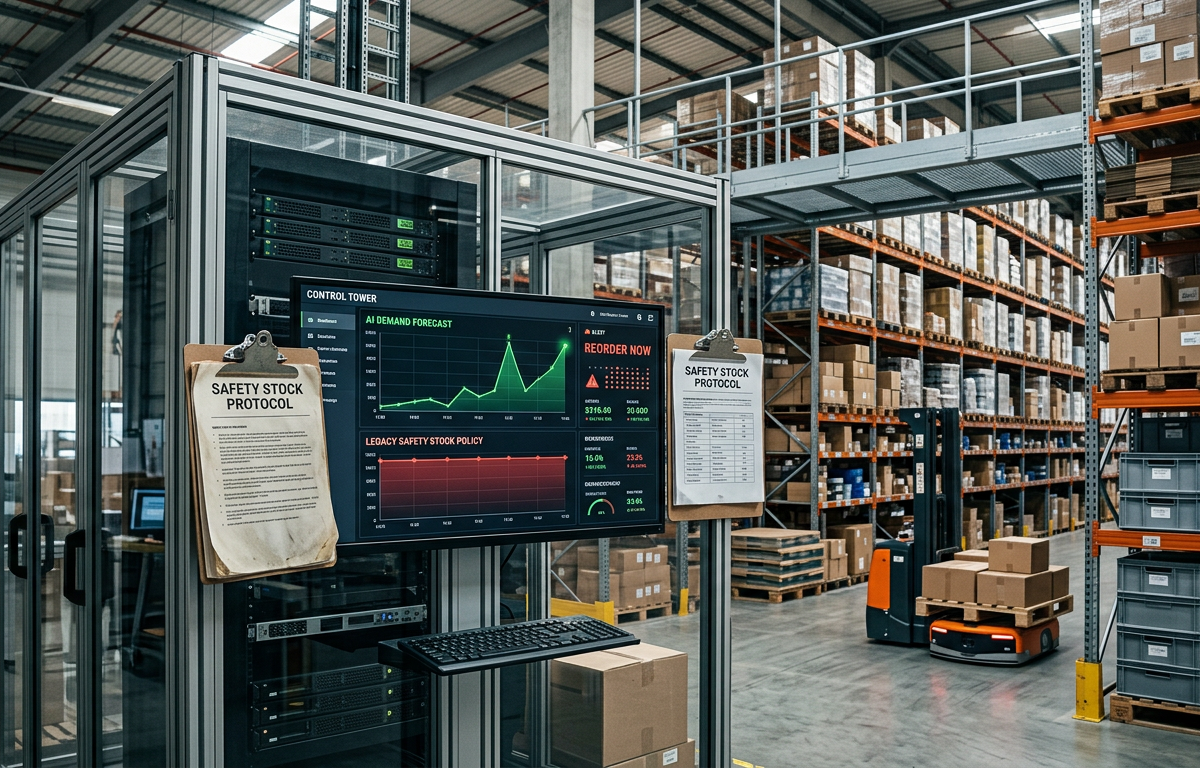
Deploying demand sensing AI without retiring legacy safety stock policies creates a hidden cost: dual everyday work. Inventory planners second-guess AI recommendations, override autonomous reorder points, and maintain manual guardrails 'just in case.' This article quantifies the cost of running both systems, explains why most deployments fail at the governance layer, and outlines the workflow clarity required to let one system own inventory decisions.
Related Articles
Operational workflow improvement
Why Fortune 500 Supply Chain AI Fails at Mid-Market: The Complexity Mismatch Problem
Fifty-seven percent of supply chain leaders cite data quality as the primary barrier to AI adoption. Not model accuracy. Not cost. Data quality. Most mid-market distributors have data spread across five to seven systems with no single source of truth. You cannot train an AI model on conflicting data. The unglamorous work of master data management, integration, and governance must come first.
Operational workflow improvement
Inventory Decisions Under Uncertainty: When AI Forecasts Conflict With Safety Stock Rules
Deploying demand sensing AI without retiring legacy safety stock policies creates a hidden cost: dual everyday work. Inventory planners second-guess AI recommendations, override autonomous reorder points, and maintain manual guardrails 'just in case.' This article quantifies the cost of running both systems, explains why most deployments fail at the governance layer, and outlines the workflow clarity required to let one system own inventory decisions.
Was this article useful?