

Agentic Supply Chain Orchestration: Controlled Automation Across Multi-Depot Networks
Most mid-market distributors allocate stock across depots manually. A buyer reviews demand signals, checks inventory levels, and decides where to send stock. This takes hours or days. By then, demand has shifted. Autonomous agents change this by making allocation decisions in real-time — but only if governance frameworks define the boundaries within which they operate.
Multi-Depot Inventory Allocation: When Autonomous Agents Decide Stock Distribution Across Locations
A Nottingham-based plumbing merchant operates five depots across the East Midlands. When demand for 22mm copper pipe spikes at their Leicester branch, the buyer reviews stock levels at all five locations, checks delivery schedules, calculates carrying costs, and emails the warehouse manager. By the time the transfer is approved, the contractor has ordered from a competitor. This happens 15-20 times per week.
Most mid-market distributors allocate stock across depots manually. A buyer reviews demand signals, checks inventory levels, and decides where to send stock. This takes hours or days. By then, demand has shifted. The result: carrying costs compound, fulfilment slows, and stockouts persist despite adequate system-wide inventory. The workflow delay costs more than the occasional wrong decision.
This article examines how agentic AI changes inventory allocation by making controlled automation in real-time, the governance frameworks required to trust those decisions, and the implementation realities distributors face when moving from manual coordination to autonomous stock distribution.
The Manual Allocation Problem: Cost and Speed
Most distributors with multiple depots manage stock allocation through spreadsheets, email chains, and weekly review meetings. A buyer receives a demand signal - a large order, a seasonal trend, a regional promotion - and manually calculates where stock should sit. This involves checking current inventory at each location, reviewing recent sales velocity, estimating future demand, and coordinating with warehouse managers.
The process takes 2-4 hours per allocation decision. For a distributor with five depots and 10,000 SKUs, this means dozens of allocation decisions per week. Each decision lags demand by 24-48 hours. During that lag, carrying costs accumulate, fulfilment opportunities pass, and stockouts occur despite adequate system-wide inventory.
A West Midlands electrical wholesaler carried £340,000 in excess slow-moving stock across seven depots while simultaneously experiencing stockouts on fast-moving lines at three locations. The allocation process was manual, reactive, and slow. Buyers knew where stock should move but lacked the time to execute decisions at the pace demand required (WithPraxis client data, 2024).
Across our implementations, workflow delay costs 3-8% of gross margin annually. The cost is not just carrying excess stock. It is the lost sales from stockouts, the expedited freight to fix allocation errors, and the buyer time spent coordinating transfers instead of sourcing better deals.
How Agentic AI Changes Allocation: Real-Time Controlled Automation
Agentic AI perceives demand signals in real-time, calculates optimal allocation across depots, and executes without human approval gates. Gartner defines agentic AI as "autonomous or semiautonomous software entities that use AI techniques to perceive, make decisions, take actions and achieve goals." In inventory allocation, this means the system decides where stock should sit based on demand forecasts, carrying costs, and fulfilment speed, then moves it.
Consider a demand spike for Product X in Region B. The manual process: buyer notices the spike on Monday morning, checks stock levels at all depots, calculates transfer costs, emails the warehouse manager, waits for confirmation, and schedules the transfer for Wednesday. The agentic process: the system detects the spike Sunday evening, calculates that Depot A has excess stock with low local demand, determines that transferring 200 units optimises fulfilment speed and carrying cost, and schedules the transfer for Monday morning. The decision takes 90 seconds.
Decisions that took hours now take seconds. A foodservice distributor in Yorkshire manages perishable inventory across four depots. Demand shifts daily based on weather, events, and seasonal patterns. Manual allocation meant stock frequently aged out at one depot while another stocked out. After deploying autonomous allocation, waste dropped 22% and stockout rate fell from 11% to 3% (WithPraxis client data, 2024).
Typical deployment for multi-depot allocation systems takes 8-12 weeks. The agent trains on historical demand data, learns depot-specific patterns, and tests allocation decisions against actual outcomes before going live. The system connects to existing ERP and WMS platforms.
The Governance Question: Why Autonomous Doesn't Mean Uncontrolled
Most distributors hear "the system decides" and imagine runaway algorithms making catastrophic allocation errors. Governance frameworks define decision boundaries upfront and address this risk.
Governance means defining which SKUs the agent can allocate, which depots it can coordinate between, which cost thresholds it must respect, and which scenarios require human override. The agent operates within these boundaries. It executes the rules you define, faster and more consistently than a human team can.
Our AI readiness assessments show a baseline score of 5.6 out of 10 across mid-market distributors. Most organisations lack governance frameworks before deployment. They have allocation rules, but those rules sit in buyers' heads or in outdated process documents. Deploying agentic AI forces clarity: you must define the rules the agent will follow.
A concrete example: an agent can reallocate up to £5,000 of stock per decision autonomously. Decisions between £5,000 and £10,000 are executed but flagged for review within 24 hours. Decisions over £10,000 require human approval before execution. This balances speed with control. The agent handles 85-90% of allocation decisions autonomously, while high-stakes decisions remain human-reviewed.
Governance also includes audit trails. Every allocation decision is logged: what the agent decided, why it decided that, what data it used, and what the outcome was. If an allocation decision results in a stockout or excess inventory, the decision owner can review the audit trail and adjust the rules. The system learns, but within boundaries you control.
Workflow Ownership and Accountability in Autonomous Allocation
When the agent decides, who owns the outcome? Governance frameworks must assign workflow ownership before the agent goes live.
The supply chain manager owns allocation rules: which depots coordinate, which SKUs are eligible for transfer, what demand thresholds trigger reallocation. Finance owns cost thresholds: maximum transfer cost per decision, carrying cost calculations, margin impact assessments. Operations owns fulfilment constraints: delivery lead times, warehouse capacity, driver availability. The agent executes within these boundaries. The decision owners define the boundaries.
Consider this scenario: an allocation decision moves stock from Depot A to Depot B, optimising overall margin by 4%. This results in a stockout at Depot A for a local customer who orders weekly. The customer complains. Who decides if that trade-off is acceptable? The decision owner, defined upfront. If the supply chain manager owns allocation rules, they decide whether local customer service outweighs system-wide margin optimisation. The agent then learns that preference and applies it to future decisions.
Without clear ownership, accountability diffuses. The buyer blames the system. The system administrator blames the data. The finance team blames the cost model. Nobody owns the decision, so nobody improves it. Workflow Mapping and Architecture clarifies ownership before deployment. We map 40-60 operational workflows, assign owners, and define escalation paths.
Ownership also means the authority to override. If the agent makes an allocation decision that conflicts with operational reality - a depot closure, a supplier delay, a customer commitment - the decision owner can override it. The override is logged, the agent learns from it, and the rules are updated.
Implementation: From Manual to Autonomous in 8-12 Weeks
Deploying autonomous allocation is an 8-12 week implementation with defined phases and measurable milestones.
Week 1-2: workflow mapping. What allocation rules exist today? Who makes allocation decisions? What data do they use? What constraints do they respect? This phase surfaces the implicit rules buyers follow but have never documented. Most distributors discover they have 15-25 allocation rules that nobody has written down.
Week 3-4: data quality assessment. Demand signals must be accurate. Inventory data must be real-time. Cost data must be current. Most distributors find gaps: demand forecasts are weeks old, inventory counts are manually updated, carrying costs are estimates from two years ago. Fixing these gaps is not optional. The agent's decisions are only as good as the data it uses.
Week 5-8: agent training and testing. The system trains on 12-24 months of historical data, learning depot-specific demand patterns, seasonal trends, and cost structures. It then runs scenario tests: what would it have decided in past situations, and how would those decisions have performed? This phase identifies edge cases and refines workflow rules before the agent touches live inventory.
Week 9-12: pilot deployment. Start with one depot or one product category. The agent makes allocation decisions, but a human reviews them before execution. After two weeks, if decisions are sound, the agent moves to autonomous execution with monitoring. After four weeks, expand to additional depots or categories.
Clients achieve 39% improvement in operational metrics within six months post-deployment (WithPraxis proprietary data, 2025). "Improvement" means faster allocation decisions, lower carrying costs, fewer stockouts, and reduced buyer workload. A Midlands distributor reduced allocation decision time from 3 hours to 15 minutes, cut excess stock by £180,000, and reduced stockout rate from 9% to 2%.
This requires cross-functional alignment. Supply chain, finance, operations, and IT must agree on workflow rules, data standards, and governance frameworks. Most distributors underestimate the coordination effort. The technology deployment is straightforward. The organisational alignment is harder.
Conclusion
Autonomous allocation is not about removing humans from inventory decisions. It is about removing workflow delay. Governance frameworks make this safe and repeatable. The question is not "should we automate allocation?" but "how do we define the rules the agent operates within?"
Organisations that clarify workflow ownership and governance first move faster and capture more value. Those that deploy agentic AI without governance frameworks create risk without reward. The technology works. The question is whether your organisation is ready to define the boundaries within which it operates.
Learn more about Predictive Replenishment System.
Common questions
How does workflow delay in manual inventory allocation impact a distributor's financial performance?
Workflow delay typically costs mid-market distributors between 3% and 8% of their gross margin annually. These losses stem from accumulated carrying costs, lost sales during stockouts, and the requirement for expedited freight to correct allocation errors. Manual processes often lag demand signals by 24 to 48 hours, preventing stock from reaching the necessary depot before a customer switches to a competitor.
What specific operational improvements can a distributor expect when moving from manual to autonomous stock distribution?
Distributors can achieve significant reductions in waste and stockout rates by eliminating human approval gates in the allocation process. For example, a foodservice distributor saw waste drop by 22% and stockout rates fall from 11% to 3% after deploying autonomous systems. The speed of everyday work shifts from hours or days to approximately 90 seconds, allowing for real-time responses to volatile demand.
How is control maintained over agentic AI to prevent unauthorised or high-value allocation errors?
Control is maintained through governance frameworks that define specific decision boundaries, such as SKU types, depot locations, and financial thresholds. An agent might be permitted to reallocate stock up to £5,000 autonomously, while decisions exceeding £10,000 require human approval before execution. This structure ensures the system executes predefined rules consistently without the risk of runaway algorithms.
What is the typical implementation timeline and technical requirement for deploying autonomous allocation agents?
Deployment of multi-depot allocation systems generally takes between 8 and 12 weeks. The agent requires a training period on historical demand data to learn depot-specific patterns and test decisions against actual outcomes. These systems are designed to connect directly to existing ERP and WMS platforms, avoiding the need for a full rip-and-replace of current infrastructure.
Tags
Themes

Andrew Pemberton
Co-founder & Development Director
Andrew is a co-founder of WithPraxis. With 25 years in commerce and technology development, he leads the build side of every engagement, turning AI strategy into working systems that fit how mid-market businesses actually operate. He has delivered projects across distribution, manufacturing, and retail for businesses from regional independents to national operators.
Connect on LinkedInMore in this cluster
Continue exploring this topic

Commerce operations insights and applications
Agentic AI Observability: Detecting When Your Autonomous Systems Are Operating on Bad Data
Agentic systems fail quietly. A pricing agent drifts 2% below target margin over eight weeks, processing 4,200 decisions before anyone notices. Margin leakage: £87,000. The agent didn't crash or throw errors—it just made slightly wrong decisions, consistently, for two months. Gartner predicts 40% of agentic AI projects will be cancelled by 2027, primarily due to silent degradation that compounds into operational disasters.
Operational workflow improvement
Why Fortune 500 Supply Chain AI Fails at Mid-Market: The Complexity Mismatch Problem
Fifty-seven percent of supply chain leaders cite data quality as the primary barrier to AI adoption. Not model accuracy. Not cost. Data quality. Most mid-market distributors have data spread across five to seven systems with no single source of truth. You cannot train an AI model on conflicting data. The unglamorous work of master data management, integration, and governance must come first.
Operational workflow improvement
Inventory Decisions Under Uncertainty: When AI Forecasts Conflict With Safety Stock Rules
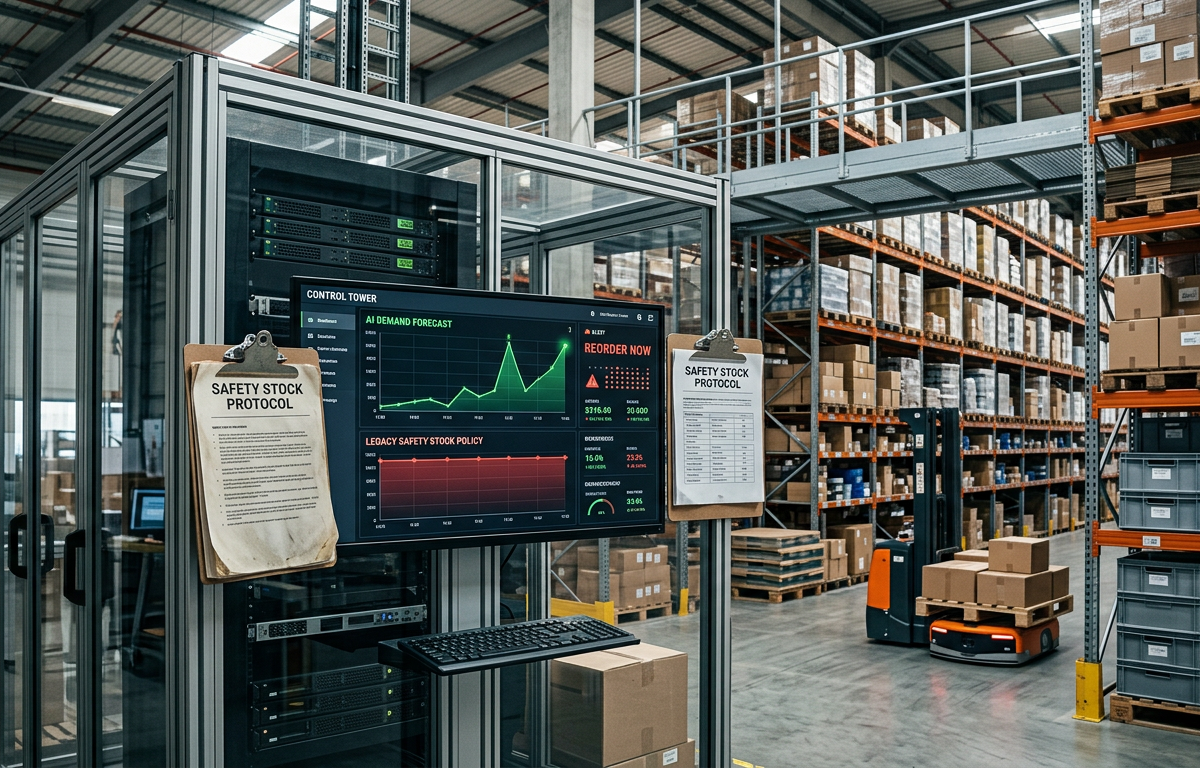
Deploying demand sensing AI without retiring legacy safety stock policies creates a hidden cost: dual everyday work. Inventory planners second-guess AI recommendations, override autonomous reorder points, and maintain manual guardrails 'just in case.' This article quantifies the cost of running both systems, explains why most deployments fail at the governance layer, and outlines the workflow clarity required to let one system own inventory decisions.
Related Articles
Operational workflow improvement
Why Fortune 500 Supply Chain AI Fails at Mid-Market: The Complexity Mismatch Problem
Fifty-seven percent of supply chain leaders cite data quality as the primary barrier to AI adoption. Not model accuracy. Not cost. Data quality. Most mid-market distributors have data spread across five to seven systems with no single source of truth. You cannot train an AI model on conflicting data. The unglamorous work of master data management, integration, and governance must come first.
Operational workflow improvement
Inventory Decisions Under Uncertainty: When AI Forecasts Conflict With Safety Stock Rules
Deploying demand sensing AI without retiring legacy safety stock policies creates a hidden cost: dual everyday work. Inventory planners second-guess AI recommendations, override autonomous reorder points, and maintain manual guardrails 'just in case.' This article quantifies the cost of running both systems, explains why most deployments fail at the governance layer, and outlines the workflow clarity required to let one system own inventory decisions.
Was this article useful?