

Client Success Stories: Real ROI from Applied AI
Real ROI from applied AI across five distribution verticals. Anonymous case studies showing measurable outcomes: 6% margin improvements, 18% fulfilment cost reductions, and 90% error elimination. Implementation timelines, effort required, and lessons learned from actual client engagements.
Client Success Stories: Real ROI from Applied AI
Most AI ROI claims in B2B commerce sound impressive until you ask for specifics. The numbers dissolve into "potential value" or "anticipated improvements" - consultant speak for unmeasured promises.
These case studies are different. Every figure comes from measured outcomes at real client engagements. The businesses are anonymous, but the results are verified: pricing decision speed, fulfillment cost reduction, margin recovery, and operational efficiency improvements across five distribution verticals.
Results vary by implementation context, existing systems, and team capability. What remains consistent is the approach: we start with specific operational workflows, build focused applications, and measure outcomes against defined baselines.
Foodservice Distribution: From 3-Day Pricing to 30-Minute Decisions
A £60M-£100M foodservice distributor managing 12,000+ SKUs faced a pricing crisis that cost them over £200,000 annually. Their pricing cycle took three days: spreadsheet updated, emailed for approval, queried, corrected, re-approved, then uploaded to systems. In volatile commodity markets, margins eroded before price changes went live.
The challenge was operational, not technical. Commodity prices shifted daily. Customer contracts included complex volume tiers and promotional pricing. The finance team worked weekends to keep pricing current, but manual processes created bottlenecks.
We deployed Dynamic Pricing Intelligence over six weeks, starting with one high-volatility product category. The pilot proved the approach before full deployment across all categories at 90 days.
Pricing decision time dropped from three days to 30 minutes. Margin improvement reached 6% across the category. Pricing errors fell by 90%. Annual margin recovery totalled £180,000-£240,000.
Foodservice distribution benefits uniquely from rapid pricing response. Perishable inventory, volatile commodities, and tight customer margins mean every day matters. The ability to adjust prices within hours rather than days proved transformational for competitiveness.
Building Materials: Solving Complex Multi-Depot Routing
A £40M-£80M construction supply distributor with 200 - 400 employees struggled with mixed-load deliveries. Orders combined bricks, timber, cement, and steel, each with different handling requirements, vehicle constraints, and site access limitations. Route planning relied entirely on driver knowledge and manual coordination.
The operational complexity was substantial. Construction sites often had narrow access windows. Some locations required crane offloading, others needed tail-lift delivery. Drivers knew customer preferences and site quirks, but this knowledge wasn't systematised. High fulfillment costs and missed delivery windows became competitive disadvantages.
Route efficiency varied dramatically across the seven-depot network. Experienced drivers managed complex loads effectively. New drivers struggled with optimisation. No systematic approach existed for improving overall network performance.
We implemented Smart Fulfillment Engine over eight weeks, piloting with one depot before network-wide deployment at 120 days. The system learned from existing driver decisions while optimising for cost and time efficiency.
Fulfillment costs dropped 18% network-wide. Delivery times improved 30% on average. On-time delivery rate reached 98%. Route efficiency improved 40 - 60% across all depots, not just those with experienced drivers.
The sustainability came from capturing institutional knowledge. Driver expertise became systematic intelligence rather than individual capability. New routes leveraged collective experience while maintaining the flexibility construction sites demand.
Industrial Distribution: Making Technical Search Actually Work
An £80M-£150M industrial distributor with 50,000+ SKUs faced a product discovery crisis. Their ecommerce platform served trade customers who knew exactly what they needed but couldn't find it online. Search failed on part numbers, specifications, and cross-references. Over 60% of orders remained phone-based despite significant online investment.
Technical product search presents unique challenges. Customers search by manufacturer part numbers, dimensional specifications, compatibility requirements, and industry terminology. Standard keyword search cannot handle the complexity. Product catalogues contain millions of potential search terms across hundreds of technical attributes.
Every phone order cost £12 in handling time. Customer satisfaction suffered when experienced counter staff couldn't answer complex technical queries. Self-service failure drove customers to competitors with better online experiences.
We deployed AI Search over six weeks, training the system on 18 months of search queries, successful orders, and customer service interactions. The implementation focused on understanding technical language and product relationships rather than generic relevance.
Search relevance improved 40 - 60% across technical queries. Product discovery significantly enhanced customer experience. Phone orders dropped 25% as customers shifted to successful self-service. Customer satisfaction scores increased measurably.
Industrial search success requires understanding domain expertise. Generic search algorithms fail because technical products have complex relationships and multiple valid search paths. Success comes from learning how experienced staff help customers find products.
Cross-Sector Insights: Workflow Mapping and Data Integration
Two engagements illustrate foundational capabilities that enable other improvements. A £30M-£80M distributor struggled with data spread across five systems: ERP, commerce platform, WMS, CRM, and accounting. Teams worked from different numbers. Integration was maintained by one person, a critical failure point.
We implemented Bytebard Data Mesh over eight weeks, connecting all five systems without replacing any. Integration time reduced 60%. Real-time data visibility emerged across all systems. Error reduction reached 95%. Single source of truth established with under five-second data freshness.
A separate engagement focused on workflow ownership. Operational workflows - pricing, fulfillment priority, inventory allocation, credit approval - were "shared responsibility," meaning nobody was accountable. Monthly meetings revisited the same questions without resolution.
Our Workflow Mapping process identified 40 - 60 operational workflows and categorised automation potential. Sixty to 80% had automation or clarification opportunities. Workflow ownership was assigned systematically. Operational decision time reduced 25 - 40% within 90 days.
These foundational capabilities enable other improvements. Clean data supports accurate models. Clear workflow ownership enables rapid implementation. Without these basics, advanced applications struggle.
Implementation Realities: Timelines, Effort, and Expectations
Successful implementations require honest planning. Pilot deployments take 4 - 8 weeks depending on complexity. Full deployment spans 60 - 120 days for most engagements. Fashion retail markdown optimisation deployed fastest (60 days). Multi-depot routing took longest (120 days) due to operational complexity.
Client effort varies significantly. Data preparation often takes longer than anticipated. Change management requires dedicated resources. Teams need time to adjust workflows around new capabilities. Technical integration usually proceeds faster than process adaptation.
Across six measured engagements, we track 39% average improvement in targeted operational metrics (WithPraxis client data, 2024). Individual results range from 18% cost reduction to 90% error elimination. Context determines outcomes more than technology sophistication.
The most successful implementations start with specific problems rather than broad objectives. "Reduce fulfillment costs" generates better outcomes than "AI transformation." Focused applications solve defined problems. General platforms create general disappointment.
What Makes These Results Sustainable
Sustainable improvement requires ownership, not dependency. Clients own the applications we build: the models, the data, and the decision logic. No ongoing consulting required. No perpetual licensing. The capability belongs to the business.
Applied AI works better than generic AI tools because it focuses on operational workflows rather than analytical insights. Most businesses have sufficient data to support better operational outcomes. They lack systematic approaches for connecting data to decisions. Purpose-built applications bridge this gap.
Starting with workflow mapping prevents common implementation failures. Many AI projects fail because they solve problems that don't actually constrain business performance. Understanding which decisions matter most guides development priorities and ensures measurable impact.
B2B commerce complexity continues increasing. Customer expectations rise. Operational margins remain under pressure. Businesses need systematic advantages, not one-time improvements. Applied AI provides systematic capability enhancement.
These case studies represent specific operational challenges with measured solutions. If your distribution business faces similar pricing, fulfillment, or decision-speed challenges, start with understanding exactly which decisions need improvement. Learn more about Workflow Mapping.
Common questions
How can AI improve pricing decisions and reduce costs in foodservice distribution?
In foodservice distribution, AI can reduce pricing decision time from three days to 30 minutes, as seen with a £60M–£100M distributor. This led to a 6% margin improvement and annual margin recovery of £180,000–£240,000 by enabling rapid response to volatile commodity markets.
What are the benefits of using AI for multi-depot routing and fulfillment in building materials distribution?
For a building materials distributor, AI improved route efficiency by 40–60% and reduced fulfillment costs by 18% network-wide. It also improved delivery times by 30% and achieved a 98% on-time delivery rate by systematizing driver knowledge for complex mixed-load deliveries across seven depots.
Can AI improve technical product search and reduce phone orders in industrial distribution?
Yes, AI can significantly improve technical product search. An industrial distributor saw search relevance improve by 40–60% and phone orders drop by 25% after implementing AI Search, which learned from 18 months of search queries and customer service interactions to understand complex technical language.
What is the typical implementation timeline for AI solutions in distribution, based on these case studies?
Implementation timelines vary, but these case studies show rapid deployment. Dynamic Pricing Intelligence was piloted in six weeks and fully deployed in 90 days, Smart Fulfillment Engine was piloted in eight weeks and deployed network-wide in 120 days, and AI Search was deployed in six weeks.
Themes

Neil Boughton
Co-founder & Technical Director
Neil is a co-founder of WithPraxis. With more than 30 years in technical architecture and systems delivery, he sets the engineering direction for every WithPraxis platform and implementation. He specialises in the unglamorous but critical work, data pipelines, system integration, and making AI models perform reliably in production environments rather than just in demos.
Connect on LinkedInMore in this cluster
Continue exploring this topic

Commerce operations insights and applications
Agentic AI Observability: Detecting When Your Autonomous Systems Are Operating on Bad Data
Agentic systems fail quietly. A pricing agent drifts 2% below target margin over eight weeks, processing 4,200 decisions before anyone notices. Margin leakage: £87,000. The agent didn't crash or throw errors—it just made slightly wrong decisions, consistently, for two months. Gartner predicts 40% of agentic AI projects will be cancelled by 2027, primarily due to silent degradation that compounds into operational disasters.
Operational workflow improvement
Why Fortune 500 Supply Chain AI Fails at Mid-Market: The Complexity Mismatch Problem
Fifty-seven percent of supply chain leaders cite data quality as the primary barrier to AI adoption. Not model accuracy. Not cost. Data quality. Most mid-market distributors have data spread across five to seven systems with no single source of truth. You cannot train an AI model on conflicting data. The unglamorous work of master data management, integration, and governance must come first.
Operational workflow improvement
Inventory Decisions Under Uncertainty: When AI Forecasts Conflict With Safety Stock Rules
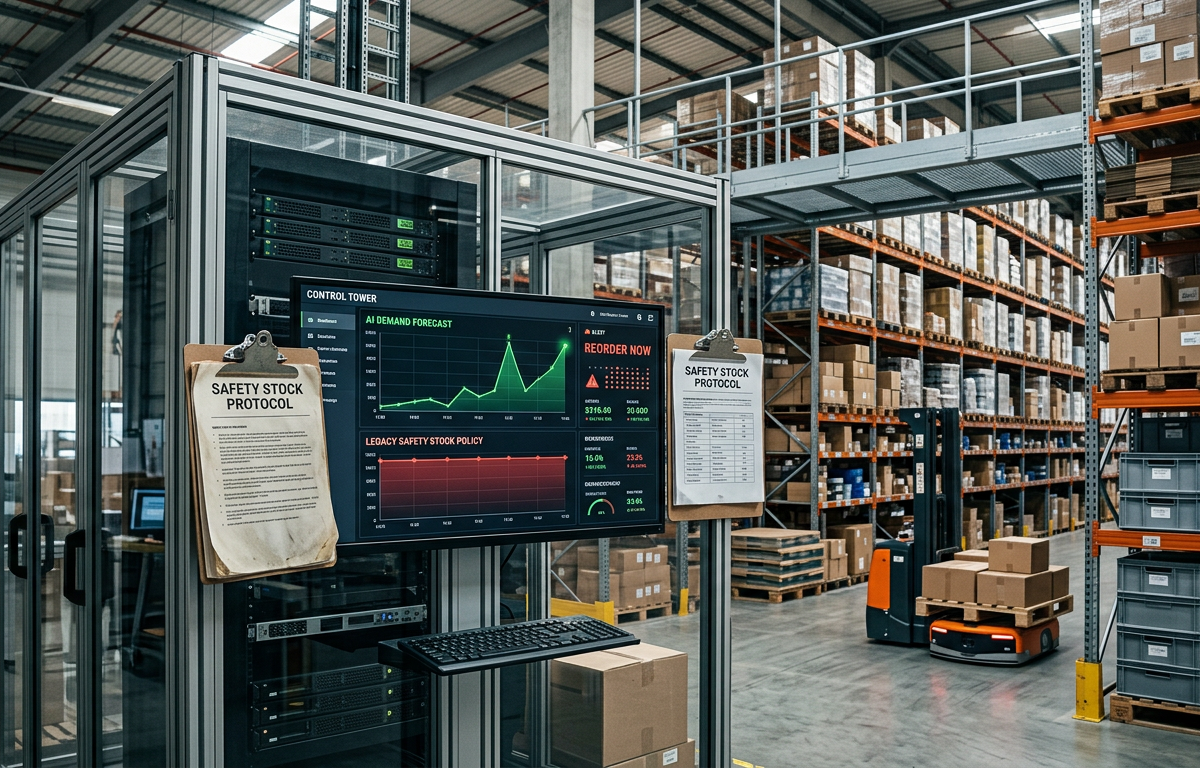
Deploying demand sensing AI without retiring legacy safety stock policies creates a hidden cost: dual everyday work. Inventory planners second-guess AI recommendations, override autonomous reorder points, and maintain manual guardrails 'just in case.' This article quantifies the cost of running both systems, explains why most deployments fail at the governance layer, and outlines the workflow clarity required to let one system own inventory decisions.
Related Articles

WithPraxis
Fashion Distribution Intelligence: How AI Transforms Seasonal Buying Decisions
Fashion distributors write off £25,000-£45,000 in dead stock each season from three decisions made six months early: style selection, quantities, and size curves. Applied AI transforms seasonal planning by handling complex optimisation while preserving buyer expertise in trend interpretation.

WithPraxis
Data Quality: The Foundation Every AI Project Needs
Eighty percent of AI initiatives fail before reaching production. The culprit isn't model complexity - it's bad data. This article examines what proper data quality assessment looks like, how migration transforms messy data into AI-ready systems, and what governance means for mid-market distributors.
Was this article useful?