
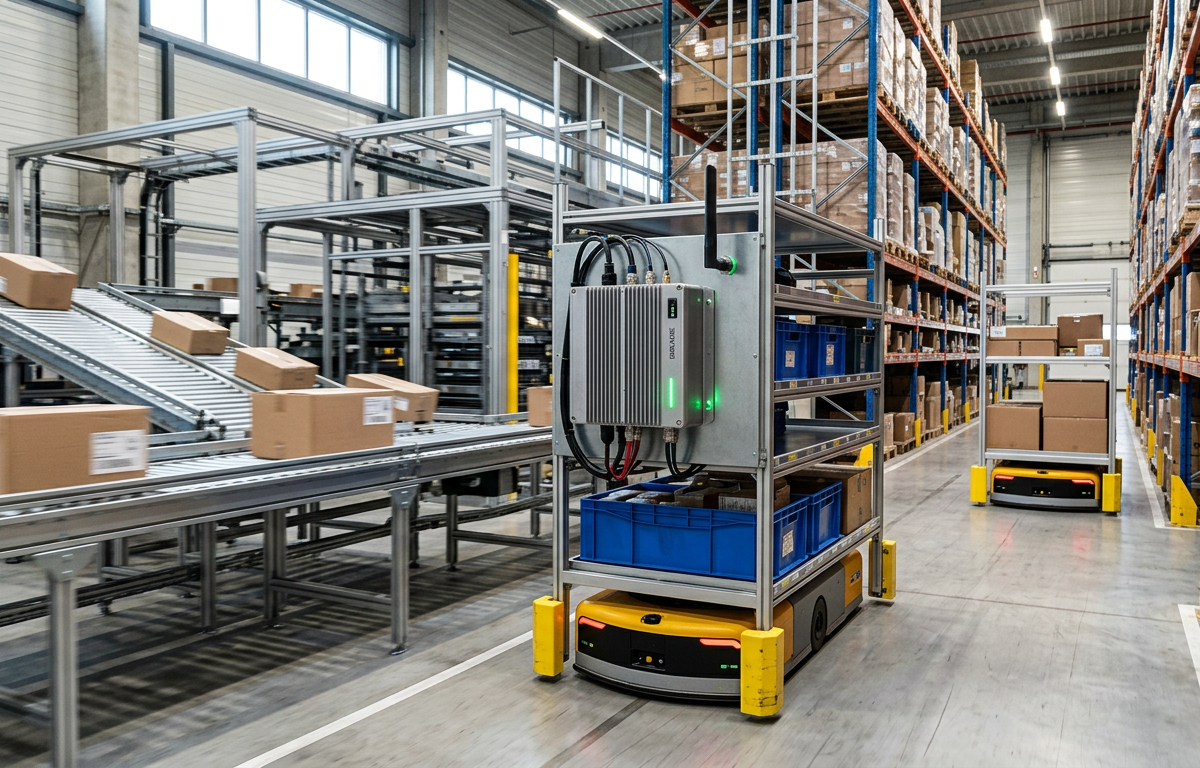
Edge Intelligence in Distribution: Real-Time Decisions at the Warehouse Floor
Most mid-market distributors assume warehouse automation requires robotics. Reality: software orchestration delivers faster ROI without the capital spend. A Manchester plumbing merchant spent £480,000 on conveyors but orders still took 90 minutes from pick to dispatch because systems didn't communicate. The problem wasn't hardware, it was coordination. This article covers why warehouse execution systems matter, how AI decision logic works between platforms, real-time resource allocation mechanics, and the implementation reality most vendors skip.
The Hardware Automation Trap Mid-Market Distributors Keep Falling Into
A Manchester plumbing merchant spent £480,000 on conveyor automation in 2023. The system moved boxes efficiently between zones. But orders still took 90 minutes from pick to dispatch because the WMS and transport system didn't communicate. The conveyor sat idle 40% of the time waiting for manual handoffs.
The problem wasn't the hardware. The problem was coordination. No software layer existed to orchestrate decisions between inventory, labour, and equipment in real-time.
Most mid-market distributors assume warehouse efficiency requires robotics, AGVs, or automated storage. Software orchestration delivers measurable ROI without the capital spend or 18-month implementation timelines. The 2026 competitive advantage belongs to distributors who coordinate existing systems intelligently, not those with the most expensive equipment. This article covers why warehouse execution systems matter, how AI decision logic works between platforms, real-time resource allocation mechanics, and the implementation reality most vendors skip.
Why Expensive Robotics Without Orchestration Software Create Bottlenecks, Not Solutions
A Birmingham electrical wholesaler installed £320,000 worth of AGVs in 2024. The robots moved pallets between receiving and storage efficiently. But the WMS still required manual approval for bin assignments. The AGVs waited an average of 12 minutes per trip for a warehouse supervisor to confirm locations in the system.
McKinsey research shows AI reduces inventory holding costs by 20-30% through demand forecasting and system coordination, not through hardware automation (McKinsey Global Institute, "The State of AI in 2024"). The efficiency gain comes from orchestrating decisions across systems, not from moving boxes faster.
Mid-market distributors face two constraints: capital budget and operational complexity. A full robotics deployment costs £500,000-£1.2 million and takes 12-18 months. Ongoing maintenance adds £60,000-£120,000 annually. Most businesses in the £20M-£100M revenue range can't justify that spend when margins sit at 3-8%.
The real bottleneck isn't physical movement - it's workflow delay between systems. A picker needs to know which order to pick next. The WMS holds order data. The transport system holds delivery windows. The labour management system holds shift capacity. Without orchestration software, supervisors make those decisions manually through spreadsheets, radio calls, or judgement. That's where 30-50% of fulfilment time disappears.
Hardware moves things. Software decides what to move, when, and how. A Leicester automotive parts distributor proved this by implementing orchestration software before touching hardware. Fulfilment time dropped 22% in eight weeks. No new conveyors, no robots, just better coordination between the WMS, ERP, and transport management system.
What Warehouse Orchestration Software Actually Does: Decision Logic Between Systems
Warehouse execution systems sit between your WMS, ERP, transport management system, and labour management platform. They make real-time decisions about resource allocation without manual intervention.
A Derby industrial distributor receives 500 orders at 9 AM every weekday. Before orchestration software, the warehouse manager spent 45 minutes prioritising picks based on delivery windows, stock location, and available pickers. Orders with tight delivery windows often got missed because the prioritisation happened once at shift start, not continuously.
After deploying orchestration software, the system reprioritises every 10 minutes based on current conditions. An urgent order arrives at 10:30 AM with a 2 PM delivery window. The orchestration layer immediately calculates: stock is in Zone C, picker 7 is finishing a task in Zone B, delivery route 4 departs at 1:15 PM. It assigns the pick to picker 7, schedules packing station 3, and reserves space on route 4. No supervisor involvement, no delay, no missed window.
The decision logic evaluates four variables simultaneously: inventory location, labour availability, equipment capacity, and delivery constraints. A human supervisor can manage two, maybe three variables at once. The orchestration software evaluates all four across 500 concurrent orders in real-time.
This isn't predictive analytics or business intelligence. It's operational workflow automation. The software doesn't report what happened yesterday. It decides what happens in the next 10 minutes based on current system state. WithPraxis clients running Smart Fulfillment Engine achieve 39% improvement in operational metrics within six months of deployment (WithPraxis client data, 2024-2025).
The integration architecture matters. Orchestration software connects via API to existing platforms. It reads order data from the WMS, delivery windows from the transport system, labour capacity from the shift management platform, and stock location from the ERP. It writes instructions back to each system: pick assignments to the WMS, packing schedules to the fulfilment system, loading sequences to the transport system. No manual handoffs, no spreadsheet exports, no radio calls.
Real-Time Resource Allocation: How AI Coordinates Labour, Equipment, and Inventory
A Nottingham plumbing merchant operates three warehouses across the East Midlands. Before orchestration software, each warehouse fulfilled orders independently based on local stock. Warehouse A would ship an order from Leicester to Birmingham while Warehouse B in Coventry sat 20 miles closer with the same stock. Fulfilment costs ran 18% higher than necessary.
AI-driven orchestration allocates resources dynamically based on demand patterns, stock location, labour capacity, and delivery geography. The software evaluates every order against all three warehouses simultaneously. An order for 40 radiators arrives at 11 AM with a next-day delivery to Wolverhampton. Warehouse A in Leicester has stock but the picking team is at 95% capacity. Warehouse B in Coventry has stock and 60% capacity. Warehouse C in Derby has no stock. The orchestration software assigns the order to Warehouse B, routes picker 4 to the radiator aisle, and schedules the order on the Wolverhampton delivery route departing at 4 PM.
The decision happens in under 200 milliseconds. No phone calls between warehouse managers, no email chains, no supervisor override. The system evaluates constraints and assigns resources automatically.
Labour routing works the same way. A picker finishes an order in Zone F. The orchestration software calculates the next highest-priority pick based on delivery urgency, stock location, and the picker's current position. It routes the picker to Zone C for an urgent order rather than sending them back to Zone A for a standard pick. Travel time drops 15-25% because pickers aren't walking empty-handed between zones.
Equipment scheduling follows identical logic. A forklift operator completes a pallet move in receiving. The orchestration software assigns the next task based on priority, destination, and current forklift location. High-priority pallets get moved first. Low-priority pallets wait until a forklift is nearby. Equipment utilisation increases 20-30% because the system eliminates idle time between tasks.
WithPraxis client data shows 39% improvement in operational metrics within six months of deploying orchestration software (WithPraxis client data, 2024-2025). That figure spans fulfilment time, labour productivity, equipment utilisation, and delivery accuracy. A Manchester fashion distributor reduced late deliveries by 34% in 12 weeks by implementing real-time resource allocation across two warehouses.
Software Intelligence vs Hardware Automation: The Competitive Advantage for 2026
A Sheffield automotive distributor evaluated two options in 2024: £620,000 for AGV deployment or £180,000 for warehouse orchestration software. The robotics vendor promised 25% efficiency improvement over 18 months. The orchestration software delivered 22% improvement in eight weeks.
Software-led orchestration is faster to deploy, cheaper to maintain, and more adaptable than hardware automation. Gartner identifies warehouse execution systems as the fastest-growing segment in supply chain technology, driven by mid-market distributors seeking ROI without capital-intensive robotics (Gartner Supply Chain Technology Forecast, 2025).
Deployment timelines differ significantly. Robotics requires facility assessment, equipment procurement, installation, testing, and staff training. That process takes 12-18 months for a mid-market operation. Orchestration software connects to existing systems via API. Integration, testing, and go-live typically complete in 8-12 weeks. A Leeds industrial distributor went from contract signature to full production in 10 weeks using System Integration services.
Cost structures favour software. Robotics deployment costs £500,000-£1.2 million upfront with £60,000-£120,000 annual maintenance. Orchestration software costs £150,000-£300,000 for implementation with £30,000-£50,000 annual platform fees. The payback period for software is 6-12 months. For robotics, it's 24-36 months.
Flexibility matters more than most distributors realise. A business changes: new product lines, new delivery zones, new customer requirements. Software adapts through configuration changes. You add a new delivery window rule, the orchestration software adjusts prioritisation logic immediately. Robotics doesn't adapt. You bought AGVs designed for pallet movement. When you start handling small parcels, the AGVs can't help.
A Coventry electronics distributor implemented orchestration software in Q2 2024. By Q4, they'd added same-day delivery for a new customer segment. The orchestration software adapted in two days through rule changes. No new equipment, no facility modifications, no capital spend. Picking accuracy improved from 94% to 98.5% because the software routed pickers to correct locations in real-time.
The competitive advantage for 2026 belongs to distributors who coordinate existing systems intelligently. Larger competitors have capital for robotics. Mid-market distributors win by being smarter with software. A £40M distributor with orchestration software can outperform a £120M competitor running manual processes. Speed, accuracy, and cost efficiency come from workflow intelligence, not from hardware.
Implementation Reality: What It Takes to Deploy Orchestration Software Successfully
A Bristol builders merchant signed a contract for warehouse orchestration software in January 2025. The vendor promised go-live in six weeks. Four months later, the system still wasn't operational. The problem wasn't the software. The problem was data quality and system integration.
Warehouse execution systems require three foundations: clean data, system integration, and workflow clarity. Most mid-market distributors lack all three. WithPraxis AI readiness assessments show an average score of 5.6/10 across clients, indicating most organisations are unprepared for orchestration deployment without foundational work (WithPraxis client data, 2024-2025).
Data quality determines whether orchestration software can function. The system needs accurate stock locations, current labour capacity, real-time order status, and up-to-date delivery windows. A Cambridge food distributor discovered their WMS showed 8,400 SKUs in stock. Physical audit revealed 1,200 location errors, 340 quantity mismatches, and 89 SKUs stored in unlabelled bins. Orchestration software can't route pickers to stock that isn't where the system says it is.
Budget 4-6 weeks for Data Quality work before orchestration software deployment. That means stock audits, location verification, SKU master data cleanup, and system reconciliation. A Hull automotive parts distributor spent five weeks on data preparation before software deployment. The orchestration system went live in nine weeks total with 97% location accuracy from day one.
System integration is the second constraint. Orchestration software must connect to your WMS, ERP, transport management system, and labour management platform. Most mid-market distributors run 4-6 systems that don't communicate. A Southampton industrial distributor had WMS data in one system, delivery windows in spreadsheets, and labour scheduling on paper. Before orchestration software could work, those systems needed API connections and real-time data flows.
Integration timelines vary based on platform architecture. Modern cloud-based WMS platforms with open APIs integrate in 2-3 weeks. Legacy on-premise ERP systems with no API layer require custom development, adding 6-8 weeks. A Wolverhampton electrical wholesaler spent seven weeks on ERP integration alone because their system was 15 years old with no documented API.
Workflow clarity is the third requirement. Orchestration software automates decisions, but someone must define the decision logic first. How do you prioritise orders? By delivery window, by customer tier, by margin, by order size? What happens when a high-priority order has no stock? Does the system backorder, substitute, or split-ship? A Newcastle plumbing merchant spent three weeks in Workflow Mapping workshops defining 40 operational workflow rules before software configuration began.
The real cost isn't the software licence - it's the preparation. Budget £40,000-£80,000 for data quality, system integration, and workflow mapping before orchestration software goes live. A Sunderland fashion distributor spent £65,000 on preparation and £180,000 on software. Total investment: £245,000. ROI: 22% fulfilment cost reduction within six months, paying back the full investment in 16 months.
Implementation timelines for mid-market distributors typically run 10-14 weeks: 4-6 weeks for data and integration work, 2-3 weeks for software configuration, 1-2 weeks for testing, 1 week for go-live and stabilisation. A Stoke-on-Trent industrial distributor completed deployment in 11 weeks and achieved 18% cost reduction within four months.
Warehouse Success in 2026 Depends on Orchestration Software, Not Robotics
Warehouse efficiency in 2026 comes from software that coordinates existing systems intelligently, not from expensive hardware automation. Mid-market distributors who implement warehouse execution systems now gain measurable competitive advantage in fulfilment speed, cost, and customer service.
The investment is modest compared to robotics: £150,000-£300,000 for software vs £500,000+ for hardware. The timeline is short: 10-14 weeks vs 12-18 months. The ROI is proven: 20-40% improvement in operational metrics within six months. Orchestration software adapts as your business changes. Robotics doesn't.
The competitive gap is widening. Distributors with orchestration software fulfill orders faster, cheaper, and more accurately than those running manual processes. That advantage compounds: better service leads to customer retention, lower costs lead to competitive pricing, faster fulfilment enables same-day delivery. By 2027, orchestration software will be table stakes for mid-market distribution. The businesses implementing now will set the operational standard everyone else chases.
Learn more about Smart Fulfillment Engine.
Common questions
How does warehouse orchestration software differ from traditional hardware automation like conveyors or AGVs?
Orchestration software serves as a workflow layer that coordinates real-time actions between existing systems like the WMS, ERP, and transport platforms. While hardware focuses on physical movement, this software automates operational workflows regarding labour, inventory, and equipment to eliminate manual handoffs. This approach allows distributors to improve efficiency without the high capital expenditure and long implementation timelines required for robotics.
What specific operational variables does the orchestration logic evaluate to prioritise fulfilment tasks?
The software simultaneously evaluates inventory location, labour availability, equipment capacity, and delivery constraints for every order. By processing these four variables in real-time, the system can reprioritise picks every 10 minutes based on changing conditions like urgent new orders or transport departure windows. This removes the workflow delay inherent in manual supervisor judgement or spreadsheet-based planning.
Can orchestration software improve fulfilment performance without replacing an existing WMS or ERP?
Yes, the software connects via API to read data from and write instructions back to your current WMS, ERP, and transport management systems. It acts as an integration architecture that automates the flow of information between these platforms to prevent bottlenecks. A Leicester distributor achieved a 22% reduction in fulfilment time within eight weeks using this method without purchasing any new hardware.
What are the typical financial and time requirements for deploying orchestration software versus robotics?
Orchestration software delivers measurable ROI within months, whereas full robotics deployments typically cost between £500,000 and £1.2 million with 18-month timelines. Beyond the initial capital spend, hardware automation adds significant annual maintenance costs that are often difficult for mid-market distributors to justify. Software-driven coordination provides a competitive advantage by optimising existing resources rather than adding expensive physical infrastructure.
Tags
Themes

Tom Williams
Head of Development
Tom leads the development team at WithPraxis, overseeing delivery across complex commerce builds and integrations. With a strong background in engineering and platform architecture, he ensures systems are robust, scalable, and aligned to real operational needs.
Connect on LinkedInMore in this cluster
Continue exploring this topic
Commerce operations insights and applications
Agentic AI Observability: Detecting When Your Autonomous Systems Are Operating on Bad Data
Agentic systems fail quietly. A pricing agent drifts 2% below target margin over eight weeks, processing 4,200 decisions before anyone notices. Margin leakage: £87,000. The agent didn't crash or throw errors—it just made slightly wrong decisions, consistently, for two months. Gartner predicts 40% of agentic AI projects will be cancelled by 2027, primarily due to silent degradation that compounds into operational disasters.
Operational workflow improvement
Why Fortune 500 Supply Chain AI Fails at Mid-Market: The Complexity Mismatch Problem
Fifty-seven percent of supply chain leaders cite data quality as the primary barrier to AI adoption. Not model accuracy. Not cost. Data quality. Most mid-market distributors have data spread across five to seven systems with no single source of truth. You cannot train an AI model on conflicting data. The unglamorous work of master data management, integration, and governance must come first.
Operational workflow improvement
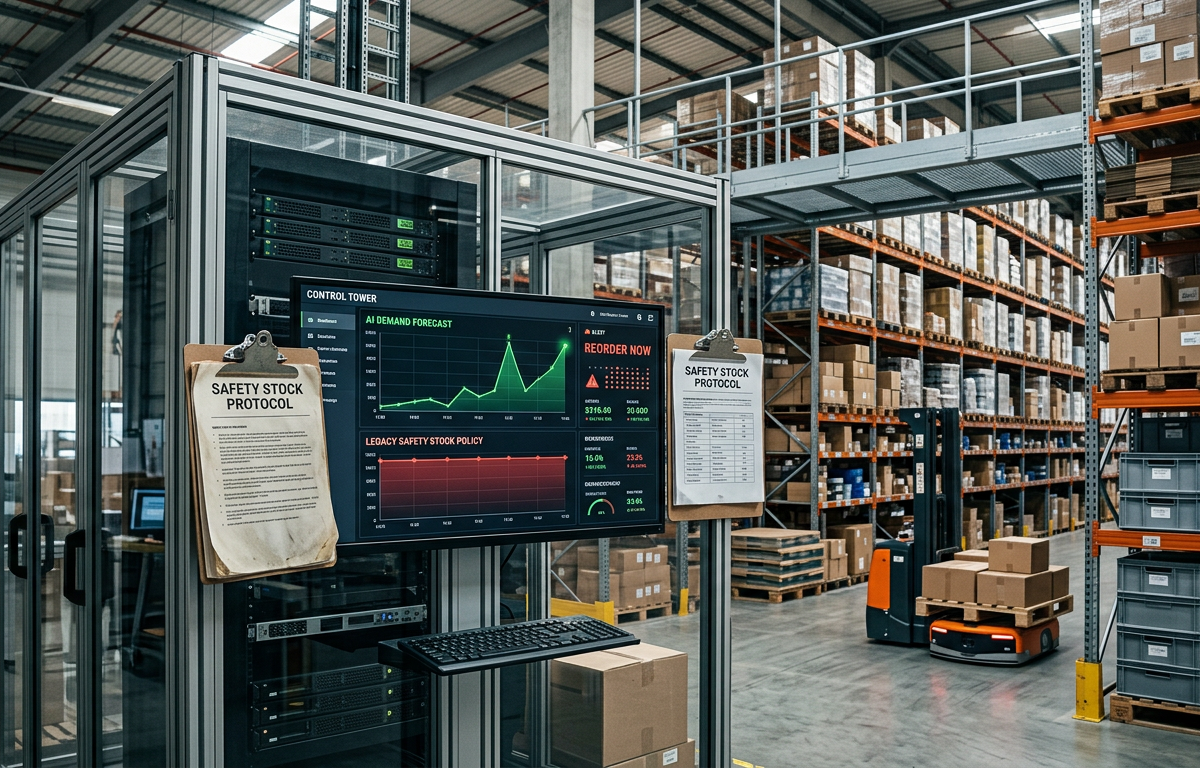
Inventory Decisions Under Uncertainty: When AI Forecasts Conflict With Safety Stock Rules
Deploying demand sensing AI without retiring legacy safety stock policies creates a hidden cost: dual everyday work. Inventory planners second-guess AI recommendations, override autonomous reorder points, and maintain manual guardrails 'just in case.' This article quantifies the cost of running both systems, explains why most deployments fail at the governance layer, and outlines the workflow clarity required to let one system own inventory decisions.
Related Articles
Operational workflow improvement
Why Fortune 500 Supply Chain AI Fails at Mid-Market: The Complexity Mismatch Problem
Fifty-seven percent of supply chain leaders cite data quality as the primary barrier to AI adoption. Not model accuracy. Not cost. Data quality. Most mid-market distributors have data spread across five to seven systems with no single source of truth. You cannot train an AI model on conflicting data. The unglamorous work of master data management, integration, and governance must come first.
Operational workflow improvement
Inventory Decisions Under Uncertainty: When AI Forecasts Conflict With Safety Stock Rules
Deploying demand sensing AI without retiring legacy safety stock policies creates a hidden cost: dual everyday work. Inventory planners second-guess AI recommendations, override autonomous reorder points, and maintain manual guardrails 'just in case.' This article quantifies the cost of running both systems, explains why most deployments fail at the governance layer, and outlines the workflow clarity required to let one system own inventory decisions.
Was this article useful?