
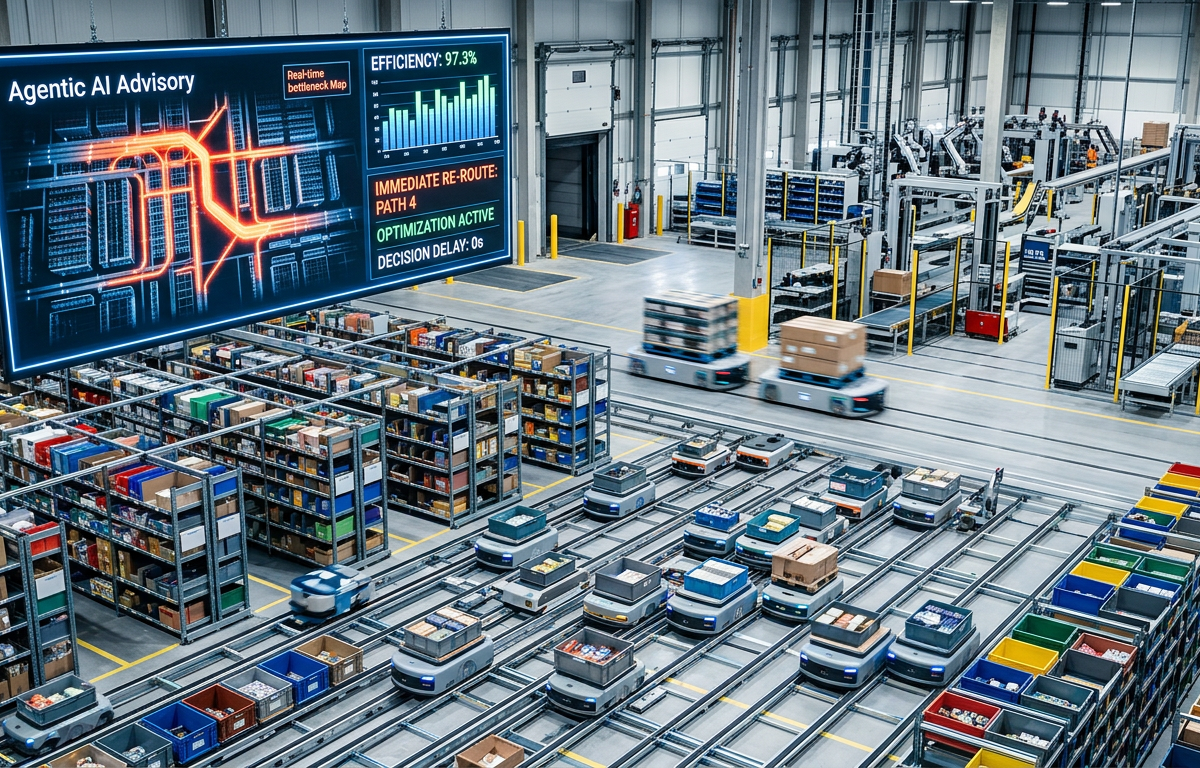
Agentic AI Advisory: When Your Operations Need Real-Time Workflow Support, Not Quarterly Reviews
A foodservice distributor takes three days to change a price. By the time the spreadsheet is approved and uploaded, the margin opportunity has passed. A seven-depot building merchant routes deliveries manually each morning, missing optimisation windows that close by 9am. A fashion retailer delays markdown decisions until stock levels force action, tying up £180,000 in slow-moving inventory for an extra six weeks. Workflow delay costs more than imperfect decisions made fast.
The Hidden Cost of Waiting: Why Delay Costs More Than Imperfection
A foodservice distributor managing 12,000 SKUs takes three days to change a price. The spreadsheet gets updated, emailed to the commercial director, queried by finance, corrected, re-approved, then uploaded to the ERP. Commodity prices for chicken, cooking oil, and flour move daily. By the time the new price goes live, the cost base has shifted again. The distributor loses £200,000 annually to this lag (WithPraxis client data, 2024).
The cost is not the occasional wrong price. The cost is systematic margin erosion from decisions that arrive too late. A building materials merchant in the West Midlands routes 40 deliveries across seven depots each morning. The logistics manager prints yesterday's orders, assigns them to drivers based on postcode and vehicle type, then adjusts for known site access constraints. This takes 90 minutes. By the time routes are finalised, the delivery window for three sites has already closed.
In volatile environments, delay costs more than imperfection. A 90% accurate pricing decision made today beats a 95% accurate decision made next week, because next week the cost structure has changed. A markdown triggered at 85% confidence today moves stock faster than a markdown triggered at 95% confidence in four weeks, because the cash is tied up for an extra month. Across WithPraxis implementations, clients report 39% improvement in key operational metrics within six months of deployment (WithPraxis client data, 2024-2025). The improvement comes from faster decisions.
When Workflow Delay Actually Kills Margin
Workflow delay is most costly in three scenarios. First, volatile input costs. A Midlands foodservice wholesaler sources from 180 suppliers with commodity-linked pricing. Chicken prices move weekly. Cooking oil prices move with crude oil futures. Flour prices track wheat markets. The commercial team reviews pricing every Monday, but changes do not go live until Thursday. In a rising cost environment, this three-day lag erodes 2-4% of gross margin on affected lines before the price adjustment takes effect.
Second, time-sensitive inventory. A fashion retailer in the South East carries 5,000 SKUs with seasonal lifecycles. The planning meeting makes markdown decisions monthly. By the time a line is marked down, it has been on the shelf for an extra four weeks. End-of-season write-offs run at 15-20% of the seasonal buy. The retailer calculates that markdown decisions made two weeks earlier would reduce write-offs by 30-40%, freeing up £180,000 in working capital per season.
Third, competitive pricing. An industrial distributor competes with three national players and a dozen regional specialists. Competitors adjust pricing in real time based on stock levels and order volume. The distributor's pricing team meets weekly to review competitor moves, then submits changes for approval. By the time the change goes live, competitors have moved again. The distributor loses 8-12 high-volume quotes per month to faster competitors, representing £240,000 in annual revenue.
These industries need decision cycles measured in minutes, not days. A foodservice distributor cannot afford a three-day pricing cycle when commodity costs move daily. A fashion retailer cannot afford a four-week markdown cycle when cash is tied up in slow-moving stock. An industrial distributor cannot afford a seven-day pricing cycle when competitors move in real time. Dynamic Pricing Intelligence compresses these cycles by removing the manual approval loop entirely.
The Decision Quality Paradox: More Information Doesn't Always Mean Better Operational Outcomes
Waiting for perfect information often means missing the decision window entirely. A building materials merchant delays delivery route optimisation until all orders for the day are confirmed. This means waiting until 10am for trade counter walk-ins to finalise. By then, morning delivery slots are gone. The merchant optimises for completeness but loses the operational window where optimisation matters.
In B2B distribution, decisions are made under incomplete information constantly. Demand forecasts are never 100% accurate. Competitor pricing is never fully visible. Cost structures change mid-cycle as suppliers adjust terms. Waiting for certainty means waiting forever. A foodservice distributor will never have perfect visibility into next month's demand because customer orders arrive with two days' notice. A fashion retailer will never have perfect visibility into which lines will sell because trends shift mid-season.
The real skill is making good-enough decisions fast, then adjusting as new information arrives. WithPraxis AI readiness assessments score mid-market distributors at an average of 5.6/10 across data quality, workflow ownership, and system integration (WithPraxis client data, 2024). Most are not optimised for speed. They are optimised for approval layers that add latency without adding value. A pricing decision that requires sign-off from three people takes three to seven days on average. Each approval layer adds 24-48 hours.
Agentic systems enable fast decisions by automating the decision loop. They decide, monitor outcomes, adjust based on new information, then decide again. A pricing agent monitors cost changes, competitor moves, and inventory levels, then recommends adjustments every hour. A routing agent optimises delivery sequences in real time as new orders arrive. A replenishment agent predicts demand, evaluates lead times, and triggers purchase orders when stock levels hit defined thresholds. The system does not wait for perfect information. It acts on available information, then adjusts.
How Agentic Systems Compress Decision Cycles
Agentic systems remove human bottlenecks from repeatable decisions. A foodservice distributor reduced pricing decision time from three days to 30 minutes by deploying an AI pricing agent. The agent monitors supplier cost updates, evaluates margin targets by customer segment, and recommends price changes in real time. The commercial director reviews exceptions only - lines where the recommended change exceeds 10%, or where customer relationships require manual judgement. 90% of pricing decisions now happen without human intervention.
A building materials merchant reduced route planning time from 90 minutes to under five minutes using Smart Fulfillment Engine. The system optimises routes as orders arrive, accounting for vehicle capacity, driver hours, site access constraints, and delivery windows. The logistics manager reviews the optimised plan each morning, adjusts for known issues (road closures, customer requests), then releases routes to drivers. The merchant cut fulfilment costs by 18% and improved on-time delivery from 76% to 98% within 120 days.
A fashion retailer automated markdown decisions using demand forecasting and inventory velocity analysis. The system evaluates sell-through rates weekly, compares them to historical patterns for similar lines, and recommends markdown timing and depth. The buying team reviews recommendations, applies commercial judgement to protect brand positioning, then approves changes. Inventory clearance accelerated by 25%, reducing end-of-season write-offs from 18% to 12% of seasonal buy.
Speed is not just about faster humans. It is about removing the human decision loop entirely for repeatable, rule-based decisions. This requires clear workflow ownership and governance. If nobody knows who is accountable for a pricing decision, an agent cannot automate it. If the rules for route optimisation are undocumented, an agent cannot apply them. Workflow Mapping identifies which decisions are automatable, which require human judgement, and which need clarification before either approach works.
The Real Trade-Off: Speed vs Control, Not Speed vs Quality
The trade-off is not between speed and quality. It is between speed and control. Fast decisions made by humans under time pressure often skip checks. A pricing manager adjusting 200 SKUs in a spreadsheet before a Monday morning deadline will miss errors. A logistics manager routing 40 deliveries in 90 minutes will miss optimisation opportunities. A buyer marking down 150 lines in a planning meeting will rely on gut feel, not data.
Fast decisions made by agentic systems are rule-based and auditable. A pricing agent can be configured with hard limits: never price below cost, never adjust trade account pricing by more than 5% without approval, never change pricing on lines with active promotions. A routing agent can be configured with constraints: never route to a site without confirmed access, never exceed driver hours regulations, never schedule deliveries outside customer-specified windows. A markdown agent can be configured with brand protection rules: never discount hero lines in the first eight weeks, never mark down below 30% of original price without approval.
Humans making fast decisions under pressure skip these checks because they are time-consuming. Agentic systems apply them automatically because they are rule-based. The real question is not "should we automate this decision?" but "do we have clear rules for this decision?" If yes, automate. If no, clarify the rules first. WithPraxis client data shows 60-80% of operational workflows have automation or clarification potential once workflow ownership is assigned.
A Midlands industrial distributor mapped 47 operational workflows across pricing, fulfilment, inventory, and credit. 12 decisions were already automated. 28 decisions had clear rules but were executed manually. Seven decisions required human judgement. The distributor automated the 28 rule-based decisions over 90 days, reducing operational decision time by 35%.
Control increases with automation when the rules are clear. It decreases when the rules are unclear, because the system will apply inconsistent logic. The path to speed is not "move faster". It is "clarify what you are deciding, document the rules, then automate the execution". Commerce Intelligence Hub provides the real-time monitoring layer that makes this possible - detecting when automated decisions produce unexpected outcomes, flagging exceptions for human review, and learning from corrections to improve future recommendations.
In volatile, time-sensitive environments, workflow delay is a margin killer. A three-day pricing cycle costs a foodservice distributor £200,000 annually. A 90-minute routing process costs a building merchant 18% of fulfilment efficiency. A four-week markdown cycle costs a fashion retailer £180,000 in tied-up working capital per season. Speed matters more than perfection.
Agentic systems enable speed without sacrificing control, but only if workflow rules are clear first. The path forward is not "move faster". It is "clarify what you are deciding, document the rules, then automate the execution". Most mid-market distributors have 60-80% of operational workflows ready for automation once ownership and rules are defined. Learn more about Commerce Intelligence Hub.
Common questions
How does workflow delay specifically impact gross margins for foodservice distributors?
Workflow delay causes systematic margin erosion by creating a gap between volatile commodity cost increases and ERP price updates. For a typical foodservice wholesaler, a three-day lag in adjusting prices for items like chicken or cooking oil erodes 2-4% of gross margin on affected lines. This delay often results in annual losses exceeding £200,000 as the cost base shifts before the new price goes live.
What is the operational cost of waiting for perfect information in delivery route optimisation?
Waiting for complete order certainty often results in missing the operational window where optimisation is actually effective. A building materials merchant waiting for final trade counter orders until 10:00 am loses access to morning delivery slots, rendering the subsequent route plan less valuable. Real-time routing agents solve this by optimising sequences as orders arrive rather than waiting for a finalised daily list.
How does the frequency of markdown decisions affect working capital for seasonal retailers?
Monthly markdown cycles trap cash in slow-moving stock for an extra four weeks, leading to end-of-season write-offs of 15-20% of the total buy. Moving to a fortnightly decision cycle can reduce these write-offs by 30-40% and free up significant working capital, such as £180,000 per season for a mid-sized retailer. Faster decisions at 85% confidence move stock more effectively than delayed decisions at 95% confidence.
Why do traditional approval layers fail to improve decision quality in B2B distribution?
Traditional approval layers typically add 24-48 hours of latency per person without necessarily improving the final outcome. In volatile markets, these manual loops ensure that by the time a price or inventory move is approved, the competitive or cost environment has already changed. Agentic systems bypass these bottlenecks by automating the decision loop, allowing for hourly adjustments based on real-time data.
Tags
Themes

Heddwyn Coombs
Co-founder & Digital Director
Heddwyn is a co-founder of WithPraxis. He has spent 30 years helping mid-market businesses make better operational decisions, first in commerce technology, now in applied AI. He works directly with MDs and ops directors to design and implement AI that earns its keep.
Connect on LinkedInMore in this cluster
Continue exploring this topic

Platform capabilities and technical insights
Composable Commerce Architecture: Building Modular Systems That Evolve With Your Business
A Midlands foodservice distributor spent £240,000 recovering from a pricing error in 2024. Their monolithic commerce platform took three days to update prices across 12,000 SKUs. Commodity costs moved faster than their approval cycle. By the time new prices went live, margins had eroded. The problem wasn't the platform. It was the architecture. Pricing, inventory, and order management sat in one system. Upgrading the pricing engine meant ripping out everything else. The platform vendor quoted 18 months and £180,000 for a custom pricing module. The distributor couldn't wait that long. This is the composable commerce question: when one component fails, can you swap it without dismantling the entire system?

WithPraxis
Fashion Distribution Intelligence: How AI Transforms Seasonal Buying Decisions
Fashion distributors write off £25,000-£45,000 in dead stock each season from three decisions made six months early: style selection, quantities, and size curves. Applied AI transforms seasonal planning by handling complex optimisation while preserving buyer expertise in trend interpretation.

Platform capabilities and technical insights
Multi-Depot Fulfilment Routing: When Driver Knowledge Isn't Enough
Manual fulfilment routing costs building materials distributors 18% in unnecessary expenses. Smart routing systems optimise multi-depot operations while preserving driver expertise.
Related Articles

Platform capabilities and technical insights
System Integration Challenges: When Legacy Meets Modern AI
A legacy ERP connects to a modern AI pricing platform. A field mapping breaks. Prices don't update. Nobody notices for 48 hours. By then, £15,000-£30,000 in margin has leaked. Silent failures are worse than loud ones because they compound. Real-time data observability makes these failures visible and resolvable before they cost money.

Platform capabilities and technical insights
LLM Observability: Why Custom AI Models Need Different Monitoring
Custom AI models degrade silently in production. Most mid-market distributors discover this weeks after the damage begins—when pricing errors accumulate, inventory misallocates, or search results decay. Model drift is silent cost leakage that compounds over time.
Was this article useful?